Simon Weiner

Notary Services for Marriage Abroad – A Complete Guide

Complete guide to notary services for marriage abroad

You may be considering a wedding in a beautiful foreign locale, but navigating the legalities can be daunting. This complete guide will provide you with vital information on notary services for marriages abroad, ensuring that your special day goes off without a hitch. From document requirements to the role of notaries in foreign countries, you’ll learn everything you need to know to make your dream wedding an enjoyable and legally binding experience. Equip yourself with the knowledge to maneuver through the global marriage landscape confidently.

Key Takeaways:

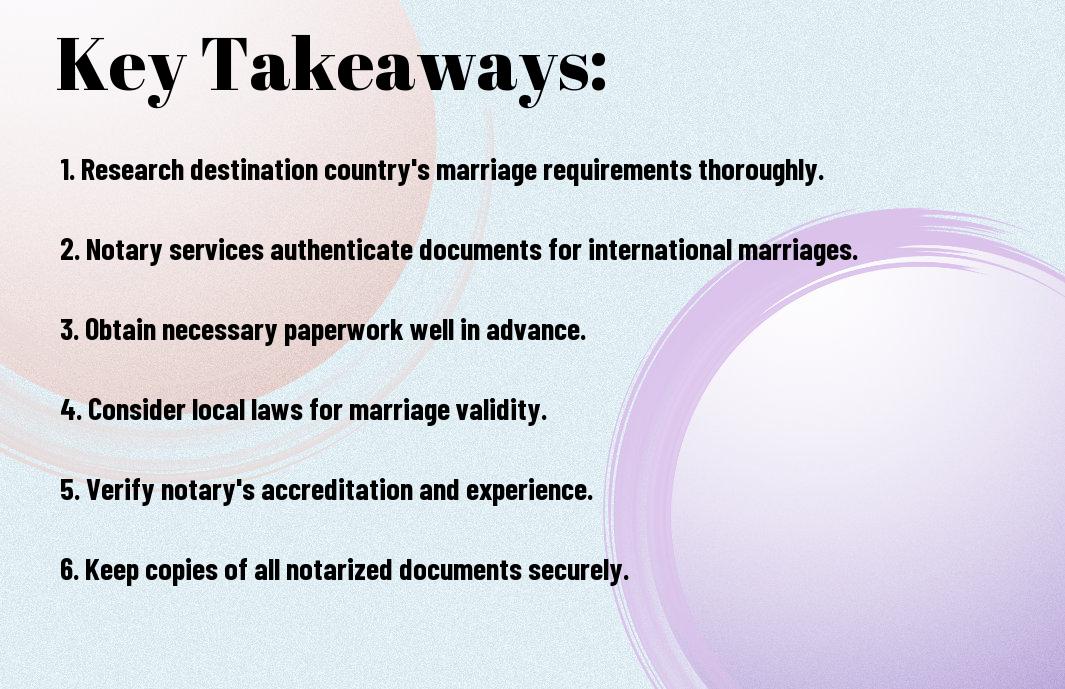
  • Understanding Requirements: Different countries have specific documentation and notary requirements for marriages abroad.
  • Notary Public Role: A notary public can authenticate documents, ensuring they meet the regulations of the destination country.
  • Documents Needed: Common documents may include identification, birth certificates, and affidavits; it’s important to verify what is necessary.
  • Legalization Process: After notarization, some documents may need further authentication, like apostille or embassy verification.
  • Consultation Services: Engage with notary services specializing in international marriage to ensure compliance and ease the process.

Understanding Notary Services

A notary service refers to the assistance provided by a licensed notary public who verifies and authenticates documents, ensuring their legality and acceptance. These services are particularly important when dealing with international matters, such as marriage abroad, where local laws and regulations must be considered to ensure compliance.

What are Notary Services?

Behind the scenes, notary services involve the official witnessing of signatures and the affirmation of documents. A notary public acts as a neutral third party, helping to prevent fraud and ensuring that all parties involved understand the contents of the documents they are signing. This process enhances the validity of legal papers in various jurisdictions, especially when venturing into international territory.

Importance of Notary Services for Marriage Abroad

For your upcoming marriage abroad, notary services can serve as a vital step in the preparation process. They not only authenticate your documents but also facilitate smoother interactions with foreign authorities, ensuring that your marriage is legally recognized.

It is vital to utilize notary services to navigate the legal requirements of a marriage abroad effectively. Without proper notarization, your documents may be deemed invalid, leading to potential issues with your marriage’s recognition in your home country. Engaging notary services also provides you peace of mind, knowing that your legal paperwork is handled correctly, allowing you to focus on your special day.
Complete guide to notary services for marriage abroad

Requirements for Notarizing Marriage Documents

The notarization of marriage documents is necessary for ensuring that your marriage is legally recognized abroad. This process involves verifying the authenticity of your documents and ensuring compliance with the laws of the destination country. You must be aware of the specific requirements that pertain to your situation in order to avoid delays or complications when getting married overseas.

Commonly Required Documents

Documents you typically need for notarization include your identification, such as a passport or driver’s license, birth certificates, and any divorce decrees or death certificates if applicable. Additionally, some countries may require a certificate of no impediment or a sworn affidavit regarding your marital status, so it’s important to gather all necessary documentation prior to your appointment.

Specific Requirements by Country

Below are some unique requirements to take into account for different countries when notarizing marriage documents. Each destination may have its own set of rules, which can vary widely based on local laws and regulations.

Specific requirements can include further documentation, such as translation of your documents into the official language of the country you are marrying in. Some nations might also mandate an apostille or consular verification of your notarized documents. It is advisable to check with the embassy or consulate of the country where you plan to marry to ensure compliance with their regulations and avoid any last-minute surprises.

The Notarization Process

Despite the complexities involved, the notarization process for marriage abroad can be streamlined. Understanding the requirements and specific steps in advance can significantly ease the procedure. You will need to gather necessary documents, seek a qualified notary public, and ensure the authenticity of your documents to fulfill your marital obligations in a foreign country.

Steps Involved in Notarization

Above all, you should familiarize yourself with the vital steps for notarization. This generally includes identifying the required documents, signing them in the presence of a notary, and having the notary affix their signature and seal. Follow these key steps to ensure a successful notarization.

Tips for a Smooth Process

Among the ways to make your notarization experience seamless, proper preparation is vital. Consider the following tips to help you navigate the process efficiently:

  • Ensure you have all necessary documents ready
  • Find a notary with experience in international marriage matters
  • Schedule an appointment to avoid long wait times
  • Ask about fees and payment options upfront

This preparation can help eliminate unnecessary delays.

But don’t overlook the significance of clear communication with your notary. Here are additional ways to enhance the notarization process:

  • Provide a list of your documents and requirements to the notary
  • Confirm any specific regulations your destination country may have
  • Verify the notary’s credentials and experience beforehand
  • Keep backup copies of all notarized documents

This diligence can save you from potential challenges down the line.

Complete guide to notary services for marriage abroad

Finding a Qualified Notary

After you decide to get married abroad, finding a qualified notary is necessary to ensure your marriage documents are legally recognized. A knowledgeable notary can guide you through the process of preparing the necessary paperwork. For insights on what to expect, check out What You Need to Know Before Saying ‘I Do’ Abroad.

How to Choose a Notary Service

Choose a notary service that specializes in international marriage documentation. Look for someone with a solid understanding of the legal requirements in the country where you plan to marry. Online reviews and recommendations can also be helpful in finding a trustworthy service.

Questions to Ask Your Notary

Across your search for a qualified notary, it’s important to prepare a list of questions that can clarify their experience and services. This ensures that you are making an informed choice that will facilitate your marriage process abroad.

Plus, asking the right questions can help you gauge the notary’s expertise. Inquire about their familiarity with the marriage laws of your destination country, processing times, and fees. Also, ask if they have experience with similar situations or any potential challenges. This information will provide you with confidence in your choice as you commence on your journey to marriage abroad.

Navigating Legal Requirements

Unlike domestic marriages, marrying abroad often involves a complex web of legal requirements. You’ll need to familiarize yourself with the specific regulations of your chosen country, including any necessary documentation, residency requirements, and the involvement of local authorities. Having a comprehensive understanding of these legalities will help ensure that your marriage is recognized both in the local jurisdiction and back home.

Understanding Legal Implications

Across different countries, the legal implications of marriage can vary significantly. It’s necessary for you to research and consult legal professionals familiar with the marriage laws in your destination country to avoid potential pitfalls. This understanding will help you navigate any requirements that could affect the validity of your marriage.

Translating Notarized Documents

Notarized documents play an important role in the legality of your marriage abroad. You may be required to have certain documents, such as birth certificates or divorce decrees, translated and notarized to meet the specific requirements of the local authorities.

Requirements for translating notarized documents can vary depending on the country in which you plan to marry. You must ensure that translations are completed by certified translators who are recognized by local authorities. This might involve using a professional translation service that can provide notarization as well, ensuring all documents are valid and properly prepared for submission. Ignoring these steps could lead to delays or complications in the marriage process, so it’s advisable to get this done well in advance.

Challenges and Solutions

Your journey to obtain notary services for your marriage abroad may present several hurdles. From navigating differing legal requirements to obtaining the necessary documentation, these challenges can be daunting. For specific guidance, you can refer to Notarial Services – U.S. Embassy & Consulates in Italy, which can help you understand the exact steps you need to take.

Common Challenges Faced

One of the most prevalent challenges you may encounter is understanding the varying requirements for documentation depending on the country where you plan to marry. This can include obtaining an apostille, translating documents, or ensuring that specific forms are completed correctly.

Solutions and Resources Available

Across the globe, there are numerous resources at your disposal to help you navigate these challenges. From consulting with legal professionals who specialize in international marriages to utilizing online platforms that offer clarity on local laws and requirements, you can find substantial support.

To further ease your stress, various government and embassy websites provide extensive resources detailing the notary services available in different countries. Engaging with these resources can help you understand what documents are necessary, how to obtain them, and any potential legal translations that may be required. Taking the time to research your options can lead to a smoother process for your marriage abroad.

To wrap up

Considering all points, securing notary services for marriage abroad is important to ensure that your marriage is recognized both legally and internationally. You need to understand the specific requirements of your destination, including the necessary documents and processes to follow. By being diligent and following this complete guide, you can navigate the complexities of international marriage with confidence, ensuring that your special day goes off without a hitch and your union is properly validated.

Q: What are the necessary documents required for notary services related to marriage abroad?

A: When preparing for marriage abroad, you typically need to provide several vital documents. These usually include your valid passport, birth certificate, and any previous marriage documents if applicable, such as divorce decrees or death certificates. It is also advisable to obtain an apostille or certification for these documents, as many countries require this to verify their authenticity. Additionally, some jurisdictions may ask for a certificate of no impediment to marriage, which confirms that you are legally free to marry.

Q: How do I find a notary service that specializes in marriage documents for international purposes?

A: To locate a notary service specializing in international marriage documents, start by searching online for notaries in your area with experience handling international marriage certificates. You can also check specific legal services websites or consult local government offices, as they may have a list of qualified notaries. Furthermore, referrals from friends or family who have previously processed marriage paperwork abroad can be helpful. Be sure to verify that the notary has the necessary credentials and understands the requirements of the country where you intend to marry.

Q: Is it necessary to have documents translated when using notary services for marriage abroad?

A: Yes, in most cases, it is necessary to have your documents translated into the official language of the country where you plan to marry. Many foreign governments require that all legal documents, including those notarized, be in their official language to ensure understanding. It is vital to use a certified translation service to ensure accuracy and compliance with the legal standards of that country. Additionally, some countries may require both the original documents and their translations to be presented for processing.

Top FAQs About UK Notary Services Answered

Top faqs about uk notary services answered

There’s a lot to consider when it comes to understanding UK notary services. Whether you’re preparing important documents for a business transaction, a legal matter, or international affairs, it’s imperative to know what notaries can do for you. In this blog post, we’ll answer the most frequently asked questions about notary services in the UK, helping you navigate this often complex area and ensuring you have the knowledge needed to proceed confidently with your notarial needs.

Key Takeaways:

  • Definition: A notary public is a qualified professional who acts as an impartial witness to the signing of documents, helping to prevent fraud.
  • Services Offered: UK notary services include document verification, certification, and administering oaths for various legal and official purposes.
  • Cost Factors: Fees for notary services can vary based on factors such as document complexity, time needed, and additional services required.
  • Availability: Many notaries offer flexible appointment times, including evenings and weekends, to accommodate clients’ needs.
  • Global Recognition: Notarized documents in the UK may require further authentication for international use, often involving apostille services.

Top faqs about uk notary services answered

What is a Notary Public?

To understand notary services in the UK, it’s necessary to know what a Notary Public is. A Notary Public is a qualified legal professional authorized to witness and authenticate documents, administer oaths, and perform various important acts, ensuring that your legal documents are valid and recognized both domestically and internationally.

Definition and Role

Against the backdrop of legal formalities, a Notary Public serves multiple functions. They primarily focus on verifying the identity of signatories, ensuring that documents are signed willingly, and preventing fraud. Their role extends to preparing official instruments and maintaining records for all notarized transactions, safeguarding your interests throughout the process.

Differences from Other Legal Professionals

Definition distinguishes a Notary Public from solicitors and barristers in significant ways. While solicitors and barristers provide legal advice and represent clients in court, a Notary Public focuses solely on document verification and authentication. This ensures a neutral stance in notarization processes, meaning you receive objective service tailored specifically to the validation of your documents.

Other legal professionals typically engage in more extensive legal matters, such as court representation, legal advice, and contract negotiation. In contrast, Notaries Public operate within a niche that emphasizes the authentication and witnessing of documents. This distinction allows them to maintain neutrality and impartiality, ensuring that your documents are executed properly and with the necessary legal standing, wherever you may need them to be used.

Top faqs about uk notary services answered

Types of Documents Notarized in the UK

If you’re seeking notary services in the UK, you may wonder what types of documents can be notarized. The following are common categories that require notarization:

  • Legal Documents
  • Personal Documents
  • Business Contracts
  • Property Deeds
  • Affidavits

Assume that you have a variety of documents requiring notarization, and it’s important to know which ones fall within these categories.

Type Description
Legal Documents Contracts, estate planning documents, and wills.
Personal Documents Affidavits, powers of attorney, and identity verification documents.
Business Contracts Agreements, partnership documents, and company formation papers.
Property Deeds Title transfers, mortgage documents, and lease agreements.
Affidavits Sworn statements used in legal proceedings.

Legal Documents

With legal documents, you often need a notary to authenticate and certify contracts, estate planning documents, or wills. These documents require stringent standards to ensure their validity and legal standing in various jurisdictions. Having a notary involved can provide you with peace of mind knowing that these sensitive papers are correctly executed.

Personal Documents

Any personal documents that require validation or verification can often be notarized. This includes affidavits, powers of attorney, and documents related to identity verification. You may need such services when dealing with matters like international travel or legal proceedings.

Documents such as powers of attorney are often used for granting someone the authority to act on your behalf, particularly in financial or medical matters. Additionally, identity verification documents help confirm your identity for various applications or processes. Having these documents notarized adds a layer of credibility and assurance that can facilitate smoother transactions.

The Notary Appointment Process

Once again, understanding the notary appointment process can streamline your experience. You’ll typically need to book an appointment in advance, which can often be done online or via a phone call. Upon your visit, the notary will verify your identity and the documents you need to sign. If you’re unsure about fees, check out this helpful resource on Public Notary in the UK who won’t rip you off for simply ….

How to Find a Notary Public

Beside knowing the appointment process, finding a notary public is fairly straightforward. You can search online directories or ask for recommendations from friends or colleagues. Many law firms and local banks also offer notarial services.

Required Documentation

Above all, it’s vital to bring the right documentation to your appointment. Be prepared to provide identification, such as a passport or driving license, along with any documents requiring notarization. Your notary will guide you through this, but having your paperwork ready can expedite the process.

With different types of documents varying in requirements, it’s wise to contact the notary beforehand to confirm what you need to bring. They may request additional items such as proof of address or specific forms related to your documents. Ensuring you have everything prepared can make your appointment efficient and hassle-free.

Fees and Charges for Notary Services

All notary services come with varying fees and charges, which can differ based on several factors. It’s important to understand these costs before engaging a notary, as it helps you budget accordingly. Generally, notaries operate transparently regarding their fees, ensuring you know what to expect beforehand.

Typical Costs

An average notary fee in the UK can range from £50 to £200, depending on the complexity and type of service required. Simple document verification will likely incur lower fees, while more intricate services such as international certifications may cost more. Always ask your notary for a detailed quote based on your specific needs.

Factors Affecting Fees

Above all, several factors can influence the fees you might encounter for notary services. These include the type of document, the time required for notarization, and any travel expenses incurred to meet your needs. Here are some of the main factors to consider:

  • Type of document being notarized
  • Complexity of the notarization process
  • Geographic location of the notary
  • Travel requirements

Perceiving the service’s specifics can help you gauge the overall cost more effectively.

This understanding can enable you to avoid any surprises when you receive your final bill. Additionally, a notary may charge extra for urgent requests or additional authentication processes. Consider these elements carefully:

  • Urgency of the request
  • Frequency of prior client use
  • Notary’s experience and expertise

Perceiving these nuances ensures you make informed decisions about the notary services you choose to engage.

Notary Services for International Use

Keep in mind that if you are planning to use your documents internationally, UK notary services play a significant role in ensuring their acceptance abroad. Notaries can help you authenticate your signatures, administer oaths, and certify various legal documents. This is important for various personal and business transactions, protecting your interests while facilitating international communication.

Apostille Process

One of the most efficient ways to validate your documents for international use is through the Apostille process. This involves obtaining a certificate that authenticates your notary’s signature and confirms the legality of the documents in countries that recognize the Hague Convention.

Legalization of Documents

Apostille is just one form of legalization; there are also instances where documents must be legalized for specific countries that do not participate in the Hague Convention. This process typically involves additional steps, such as obtaining approval from the relevant embassy or consulate. You may need to prepare multiple versions of your documents to comply with different country requirements.

For instance, if you are planning to conduct business or establish residency in a country that does not accept Apostilles, you will likely need to engage in the full legalization process. This means having your documents verified by your local authority, followed by a trip to the embassy, where they will be stamped and sealed. Being aware of these requirements can save you time and ensure that your documents are accepted without complications.

Common Myths About Notary Services

For many people, notary services are surrounded by confusion and misinformation. Common myths, such as the belief that notaries can provide legal advice or are responsible for verifying the accuracy of documents, can lead to misunderstandings about their actual role. By dispelling these myths, you can better navigate the notary services landscape and ensure you receive the assistance you need.

Misconceptions Explained

At the heart of many misconceptions about notary services lies the misunderstanding of their purpose. Notaries do not authenticate the contents of documents; rather, they serve as impartial witnesses to the signing process, helping to prevent fraud. It’s imperative to grasp this distinction to avoid relying on them for legal guidance or document validation.

Clarifying Legal Authority

To further clarify, you should know that notaries in the UK have specific legal responsibilities, which include administering oaths and verifying identities. Their authority is derived from their adherence to established regulations, ensuring a standardized process for document notarization. However, they are not qualified to offer legal advice or services beyond their defined role.

And, while notaries can help streamline the signing process and lend credibility to your documents, you should always seek legal counsel for any complex matters or concerns related to your documents. Understanding the limits of a notary’s role ensures you make informed decisions regarding your legal needs.

Final Words

Now that you have your top FAQs about UK notary services answered, you can confidently navigate the notary process tailored to your needs. Understanding the specifics will help you choose the right notary, ensure your documents are properly prepared, and clarify any queries about fees and requirements. With this knowledge, you can approach your notary services with assurance and clarity, making the experience as seamless as possible for you.

Top FAQs About UK Notary Services Answered

Q: What is the role of a notary public in the UK?

A: A notary public in the UK serves as a qualified legal professional who is entrusted with the authentication of documents for use both domestically and internationally. Notaries verify the identity of the individuals involved, witness signatures, administer oaths, and certify copies of documents. Their purpose is to ensure that the documents meet legal requirements and can be recognized in foreign jurisdictions, fostering trust and reducing the potential for fraud.

Q: How do I find a qualified notary public in the UK?

A: To find a qualified notary public in the UK, you can visit the official website of the Notaries Society, which provides a searchable database of registered notaries across various regions. You might also want to ask for referrals from legal professionals or search online. When opting for a notary, ensure they are properly qualified and have relevant experience in the type of documents you need to be notarized.

Q: What documents typically require notarization in the UK?

A: Various documents may require notarization, depending on their intended use. Common examples include powers of attorney, contracts, property deeds, and documents needed for international transactions such as affidavits and declaration of trust. In some cases, certificates of good standing or company formation documents may also need to be notarized. It is advisable to consult with the specific entity requesting the document to determine whether notarization is necessary.

How to Legalise UK Documents for Use Abroad

Legalising uk documents for use abroad

It’s imperative to understand the process of legalising your UK documents when you plan to use them abroad. This guide will walk you through the necessary steps to ensure your important papers meet the requirements of foreign authorities. You will learn about the various types of legalisation, including apostilles and embassy verification, and how to navigate the specific procedures involved. With the right knowledge, you can make the legalisation process smooth and straightforward, allowing you to focus on your international endeavors.

Key Takeaways:

  • Check Requirements: Always verify the specific legalisation requirements of the destination country, as they can vary significantly.
  • Obtain a Notary Seal: Most documents will need to be notarised before proceeding with the legalisation process.
  • Foreign Office Legalisation: After notarisation, documents must be submitted to the UK Foreign, Commonwealth & Development Office for legalisation.
  • Apostille Certificate: If the document is to be used in a country that is a member of the Hague Apostille Convention, ensure that an Apostille is attached.
  • Processing Time: Be aware of processing times, as legalisation can take several days to weeks, depending on the volume of applications.

Understanding Document Legalisation

Are you planning to use UK documents in foreign countries? Understanding the process of document legalisation is important to ensure that your paperwork is accepted abroad. This often involves a series of steps to verify authenticity and compliance with the specific legal requirements of the destination country.

What is Document Legalisation?

For your documents to be considered valid internationally, document legalisation is the process of certifying that these documents are genuine. This typically involves obtaining confirmation from various authorities, such as the notary public and the Foreign, Commonwealth & Development Office (FCDO).

Importance for International Use

Below the surface, legalising your documents is vital for their acceptance in foreign jurisdictions. Without this process, your paperwork may be viewed as invalid or unreliable, potentially jeopardising your personal or business transactions abroad.

This verification not only provides proof of authenticity but also builds trust with officials and institutions in the host country. By ensuring your documents are properly legalised, you safeguard your interests and improve your chances of a seamless and successful experience when dealing internationally.

Legalising uk documents for use abroad

Types of Documents That Can Be Legalised

You can legalise various documents for use abroad, ensuring they meet the required standards of authenticity. These typically include:

  • Personal Documents
  • Business Documents
  • Educational Certificates
  • Legal Documents
  • Medical Records

Recognizing the different categories helps streamline the legalisation process.

Document Type Description
Personal Documents Birth, marriage, and divorce certificates.
Business Documents Articles of incorporation and contracts.
Educational Certificates Diplomas and academic transcripts.
Legal Documents Powers of attorney and wills.
Medical Records Health records needed for certain visas.

Personal Documents

At the core of personal document legalisation are certificates such as birth, marriage, and divorce. These documents serve as vital records when transitioning to another country, such as for residency applications or marriage in a foreign jurisdiction. Ensuring these documents are legalised can facilitate smoother transitions and fulfil legal requirements.

Business Documents

For professionals looking to expand globally, business documents like articles of incorporation, contracts, and shareholder agreements play an important role. These documents validate your business’s credibility and are often mandatory for various international operations.

But the process is not just about obtaining signatures; you must ensure that business documents are correctly notarised and authenticated. Each country may require different levels of legalisation, so understanding the specific requirements for your target nation will aid in the efficient handling of your business affairs abroad. Comprehensive attention to detail can prevent delays and complications, allowing your enterprises to flourish on international grounds.

The Legalisation Process in the UK

Despite being straightforward, the legalisation process for UK documents can seem complex. You will need to choose between an Apostille or consular legalisation, depending on the destination country. For detailed guidance, refer to Apostille and consular legalization of documents from the United Kingdom. Understanding these options is vital to ensure your documents are valid abroad.

Steps Involved

Among the first steps in the legalisation process is determining the type of document you need to legalise. Then, gather necessary information and prepare your documents for submission to the appropriate authority, whether that’s the Foreign, Commonwealth & Development Office or the relevant embassy or consulate. It’s important to follow all guidelines precisely to avoid delays.

Common Pitfalls to Avoid

Process errors can lead to setbacks in getting your documents legalised. You should ensure that all documents are correctly formatted and meet the specific requirements of the destination country to avoid issues.

Avoid skipping the verification of your documents before submission. Providing incomplete or improperly filled documents can result in rejection. Additionally, make sure to check the legalisation timelines, as different countries may have varying processing speeds. Lastly, don’t underestimate the importance of allowing adequate time for the entire legalisation process, including any possible postal delays.

The Role of Apostille in Document Legalisation

After you have prepared your documents for international use, obtaining an Apostille is an vital step in the legalisation process. This certification is issued under the Hague Convention and ensures that your documents are recognised in foreign countries that are part of the agreement. The Apostille verifies the authenticity of the signature, stamp, and seal on your document, making it legally valid abroad.

What is an Apostille?

Against what many may assume, an Apostille is not an additional document but rather a certificate itself. It is attached to your original document, serving as proof that your document is legitimate and has been properly authenticated by a competent authority in your country.

How to Obtain an Apostille

Across various locations, obtaining an Apostille involves a streamlined process. You will need to submit your document to a designated authority, typically the Foreign Office in the UK, along with any required fees and identification. The processing time can vary based on the volume of requests, so plan accordingly.

Plus, you can expedite the process by using a professional service that specializes in document legalisation. They can guide you through the necessary steps and handle the paperwork on your behalf, ensuring that you receive your Apostille quickly and efficiently while avoiding potential pitfalls in the process.

Additional Requirements for Specific Countries

Unlike many countries, some nations have unique legalisation requirements that extend beyond the Apostille process. You may need to provide translations, specific forms, or additional certifications to ensure your documents are accepted. It’s vital to research the specific needs of the country where you intend to use your legalised documents, as failing to comply can lead to delays or rejection.

Country-Specific Regulations

After identifying the destination country, you should familiarize yourself with its legalisation laws. Some countries may require extra steps for certain document types, such as marriage certificates or academic transcripts. It’s advisable to consult the official embassy or consulate website for detailed regulations to ensure that your documents meet all requirements.

Navigating Different Legalisation Systems

Among the many challenges you might face is the variety of legalisation systems across different countries. Each country has a distinct process, and understanding these differences can simplify your journey.

Also, keeping track of various requirements can be time-consuming and complex, so you may want to consider enlisting professional services that specialize in document legalisation. They can streamline the process by ensuring your documents adhere to local regulations, ultimately saving you time and reducing the risk of errors that could lead to complications during legalisation. This assistance can be especially valuable when dealing with multiple jurisdictions or documents requiring specific attention.

Legalising uk documents for use abroad

Costs and Timeframes

Keep in mind that the costs and timeframes associated with legalising UK documents can vary significantly based on the type of document and the specific requirements of the destination country. It’s important to budget accordingly and factor in additional expenses such as notarisation, translation, and courier services, as these can all impact the overall cost of the legalisation process.

Overview of Fees

One of the first steps in planning your document legalisation is to assess the associated fees. Typically, fees may include government charges, service provider costs, and any optional extras such as expedited processing. Each document type may have different fee structures, so it’s wise to check directly with relevant authorities or service providers for accurate pricing.

Estimated Timeframes for Legalisation

Across various services, the time it takes to legalise your documents can differ widely. Generally, standard processing may take several days to a few weeks, while express services can significantly accelerate the timeline for an additional fee.

Legalisation timelines hinge on multiple factors, including the volume of applications being processed and the specific agency involved. It’s prudent to initiate the legalisation process well in advance of your intended use to avoid any potential delays. Should you require documents urgently, many service providers offer expedited options that can reduce processing times, ensuring your documents are ready for international use as quickly as possible.

Summing up

Considering all points, legalising your UK documents for use abroad involves a clear understanding of the notarisation process, obtaining an Apostille, and adhering to specific requirements set by the foreign authorities. By following the steps outlined—ensuring your documents are correctly notarised, verifying the need for an Apostille, and submitting everything to the appropriate agencies—you can efficiently prepare your documents for international acceptance. This systematic approach will help ensure that your legal documents are validated and recognised in your intended country, making your overseas ventures smoother and more manageable.

Q: What documents can be legalized for use abroad in the UK?

A: Various types of documents can be legalized, including academic certificates, marriage certificates, birth and death certificates, power of attorney documents, and commercial documents such as contracts. It is important to check the specific requirements of the country where the documents will be used, as different countries may have varying rules regarding document legalization.

Q: What is the process for legalizing UK documents for use abroad?

A: The process typically involves several steps. First, you must have the document officially notarized by a qualified notary public. Next, it should be submitted to the Legalisation Office of the Foreign, Commonwealth & Development Office (FCDO) for verification. Lastly, depending on the destination country, you may need to have the document further legalized by the relevant embassy or consulate. Always check with the specific embassy or consulate for additional requirements, as they may request extra documentation.

Q: How long does it take to legalize documents in the UK?

A: The timeframe for legalizing documents can vary based on multiple factors, including the type of document and the current processing times at the Legalisation Office. Typically, the legalization process may take anywhere from a few days to several weeks. To speed up the process, consider using expedited services offered by the FCDO, which can significantly reduce wait times. Be sure to plan ahead and allow sufficient time for completion, especially if your documents are needed by a specific date.

Notary Requirements for Immigration Applications

Notary requirements for immigration applications

With the complexities of immigration applications, understanding notary requirements is vital for ensuring the accuracy and validity of your documents. You may need to consider the role of notaries as they facilitate the proper execution of legal papers. Familiarize yourself with the specifics, including the difference between Notaries and Notarios Publicos, as they can vary in function. For more detailed information, check out this resource on Notaries, Notarios Publicos, and Immigration.

Key Takeaways:

  • Identification: Applicants must provide valid identification to the notary to authenticate their identity. This is important for the validity of the documents.
  • Signature Verification: Notaries are responsible for verifying the signatures on immigration documents to ensure they are completed properly before submission.
  • Notary Public Limitations: It’s important to understand that notaries cannot provide legal advice or represent applicants in immigration proceedings.
  • Document Types: Immigration applications may require various documents, such as affidavits and translations, which must be notarized correctly.
  • State-Specific Rules: Notary requirements can vary by state; therefore, applicants should check local regulations to ensure compliance.

Notary requirements for immigration applications

Overview of Notary Functions in Immigration

Your understanding of notary functions is vital when navigating the immigration process. Notaries play a significant role in verifying documents and facilitating the proper filing of immigration applications. They ensure that your paperwork is accurately completed and may help to prevent delays in your application due to errors. Knowing how notaries can assist you helps streamline your journey toward immigrant status.

Definition and Role of a Notary

Role of a notary includes acting as an impartial witness during the signing of documents. They verify the identity of individuals, administer oaths, and affirm the authenticity of signatures. In the context of immigration, notaries help ensure that your documents comply with legal standards, which can be vital for your application’s success.

Differences Between Notary Public and Immigration Attorney

Beside their functions, it’s important to distinguish between a notary public and an immigration attorney. While both can assist you, they serve different purposes. A notary public primarily verifies signatures and ensures that documents are executed correctly, whereas an immigration attorney provides legal advice, represents you in legal matters, and navigates the complexities of immigration law.

Definition of these differences highlights that immigration attorneys possess specialized training and are licensed to handle legal issues surrounding immigration matters. They can advocate for your case and offer personalized advice tailored to your specific situation. In contrast, notaries do not have the legal authority to provide such assistance, making the choice between the two significant based on your needs.

Notary requirements for immigration applications

Notary Requirements for Immigration Applications

The notary process plays a significant role in immigration applications, ensuring that your documents are duly authenticated. Most immigration authorities require you to submit notarized documents to validate your identity and provide an additional layer of credibility to your application. By adhering to notarial requirements, you enhance your chances of a successful application and smooth processing.

General Notarial Practices

Any notary public will guide you on general practices that ensure your documents meet legal standards. This typically involves verifying your identity, witnessing your signature, and administering an oath if required. It’s important to choose a notary well-versed in immigration-related matters, as this ensures your documents will be correctly handled and accepted by immigration authorities.

Specific Documentation Guidelines

Applications for immigration often require specific documentation that must be notarized. You should consult with your notary about which documents need to be completed following notarial protocols, including forms such as affidavits, declarations, and other supporting materials central to your case.

Understanding the specific documentation guidelines is vital for a smooth immigration process. Make sure you gather all required forms and any additional documents as specified by the immigration authorities. Different types of applications may require different sets of documents, so being precise and organized will help you avoid delays and potential issues with your application. Always check that your documents are fully completed, signed, and, most importantly, notarized according to the stringent requirements set forth for your immigration application.

Common Immigration Applications Requiring Notary Services

Many immigration applications necessitate notary services to authenticate documents and ensure compliance with legal standards. These applications often include family reunification petitions, employment-based visas, and adjustment of status requests, all of which require meticulous documentation. Maintaining accurate and notarized documents is imperative to avoid potential delays and complications in your application process.

Family-Based Immigration

On your journey towards family-based immigration, proper documentation is vital. You may need to submit forms like the I-130 Petitions for Alien Relatives, which often require notarized signatures and copies to validate your claims. Ensuring that all documentation is correctly notarized can help expedite the processing of your application and bring your family closer together.

Employment-Based Immigration

Before submitting your employment-based immigration application, it’s important to prepare your supporting documents accurately. Notarization of crucial documents such as job offers and labor certification can bolster your case and reflect professionalism in your application packet.

Notary services play an imperative role in your employment-based immigration process. Notarizing documents like Form I-140 (Immigrant Petition for Alien Worker) ensures that all signatures and statements are legally valid. This step helps prevent potential issues with the U.S. Citizenship and Immigration Services (USCIS) that could arise from improperly signed documents. By employing notary services, you can enhance the credibility of your application and increase your chances of a favorable outcome.

Validating Notary Certificates

All immigration applications often require notarized documents, making it necessary to validate notary certificates accurately. A validated notary certificate verifies that the notary public has fulfilled their duties correctly and can help strengthen your application. This process minimizes the risk of setbacks and enhances the credibility of your submitted documents in the eyes of immigration authorities.

Importance of Proper Notary Acknowledgment

Any error in the notary acknowledgment can lead to complications and potential rejection of your application. A properly executed acknowledgment confirms the authenticity of your signature and the intent behind the documentation. Ensuring that the notary’s acknowledgment is complete and correctly filled out safeguards your application process.

Checking Notary Credentials and Authority

Validating the credentials and authority of your notary is necessary for a smooth immigration process. You need to ensure that the notary is licensed, has the proper jurisdiction, and is in good standing within their state. An unauthorized or improperly connected notary can jeopardize the validity of your documents, leading to unnecessary delays.

Notary public appointments can vary by state, so it’s important for you to confirm that your notary has the legal authority to notarize documents in your jurisdiction. You can verify their status through state licensing boards or government websites. Some states even provide databases where you can check the notary’s credentials and ascertain their active status. Taking these steps ensures that your notarized document is legitimate and helps you avoid complications with your immigration application.

Potential Consequences of Improper Notarization

Once again, ensuring proper notarization is vital for your immigration applications. Failing to adhere to notary requirements can lead to significant complications that may jeopardize your case. Any discrepancies or errors in notarization can raise red flags for immigration officials, potentially undermining the credibility of your documents and application.

Application Delays

On multiple occasions, improper notarization can result in unexpected application delays. If documentation is not adequately notarized, the reviewing immigration authority may require additional verification or even return your application for corrections, extending your waiting time unnecessarily.

Risks of Fraud and Legal Issues

Below, you should be aware that improper notarization poses serious risks of fraud and legal issues. Notarized documents are expected to be genuine and reliable; any evidence of tampering or forgery could lead to severe penalties, including possible removal proceedings.

Plus, the implications of such risks can extend beyond your current immigration application. If found guilty of submission of fraudulent documents, you may face legal consequences that could affect future attempts at immigration or even result in criminal charges. Upholding the integrity of your documents not only strengthens your application but also protects you from potential legal pitfalls.

Resources for Finding Notary Services

Despite the importance of finding reliable notary services for your immigration applications, it can often be overwhelming. Thankfully, several resources are available to aid you in your search. Local community centers may offer notary assistance or can connect you with qualified professionals. Additionally, online directories can help you identify notaries in your area. Be sure to consider reviews and recommendations when selecting a notary to ensure you receive the best service possible.

State Licensing Boards

Services provided by notaries can vary, so it’s beneficial to consult your state’s licensing board. Each state has regulations that notaries must adhere to, and you can typically find a list of licensed notaries on their official website. This ensures you select a notary who is compliant with state laws and procedures, ultimately providing peace of mind as you navigate your immigration application.

Professional Notary Associations

Below are valuable tools for finding notaries: professional associations often maintain directories that include certified notaries in your area. These organizations provide resources for both notaries and clients, helping you make informed choices as you pursue your immigration goals.

And these professional notary associations also offer additional services, such as training and certification programs for notaries, ensuring they stay updated on regulations and best practices. By choosing a notary affiliated with a reputable association, you can boost your confidence in their expertise and professionalism. This connection can lead to a more efficient and accurate completion of your immigration application.

To wrap up

Now that you understand the notary requirements for immigration applications, you can ensure that your documents are properly prepared and authenticated. It’s vital to verify that any notary you choose is licensed and familiar with the specific immigration documentation you need. Keeping your records organized can streamline the process and prevent delays in your application. By following these guidelines, you enhance your chances of a successful immigration journey.

FAQ

Q: What types of documents typically require notarization for immigration applications?

A: Immigration applications may require notarized documents such as affidavits, personal statements, or declarations that provide evidence supporting the applicant’s case. Additionally, documents that prove identity, relationship to family members, and any other supporting documents may also need to be notarized to ensure their authenticity and validity in the application process.

Q: Who is eligible to serve as a notary for immigration-related documents?

A: In the United States, a notary public must be officially appointed by the state, which includes passing a background check and completing any required training or education. Notaries can be lawyers, clerks, or individuals from various professions that have met their state’s requirements. However, it is important to ensure that the notary has experience with legal documents related to immigration, as they should understand the specific requirements and potential implications for the application being submitted.

Q: What should I consider when selecting a notary for my immigration documents?

A: When dicking out a notary for immigration documents, consider their experience with immigration cases, as they will be more familiar with the necessary documentation. It’s also wise to confirm their credentials and ensure they are licensed and in good standing within their state. Additionally, inquire about their processing times and fees to avoid any unexpected issues or delays in your application submission.

Understanding the Hague Convention and UK Notarisation

Understanding the hague convention and uk notarisation

You may find yourself needing to understand the legal frameworks that govern international document recognition, specifically through the Hague Convention and UK notarisation practices. This blog post will guide you through the intricacies of the Hague Convention, which facilitates the international recognition of public documents, and how UK notaries play a pivotal role in this process. By grasping these concepts, you will be better equipped to navigate the complexities of legal documentation, ensuring your documents are valid across borders.

Key Takeaways:

  • The Hague Convention: This international treaty simplifies the process of legal document recognition across countries, particularly in matters of private international law.
  • UK Notarisation: In the UK, notarisation is the formal act of a notary public, ensuring that documents are authenticated for use overseas, particularly under Hague Convention provisions.
  • Apostille Certificate: An apostille is a certificate that verifies the authenticity of the notary’s signature and seal, allowing documents to be accepted in countries that are parties to the Hague Convention.
  • Document Types: Various types of documents, such as contracts, affidavits, and powers of attorney, may require notarisation and apostille for international use.
  • Legal Framework: Understanding the legal requirements involved in notarisation and the Hague Convention is necessary for ensuring that documents are valid and enforceable abroad.

The Hague Convention: An Overview

Your understanding of the Hague Convention is vital for navigating international legal processes, especially concerning the authentication of documents. This treaty aims to simplify the use of foreign public documents by ensuring they are recognized across borders without the need for further legal formalities.

Historical Context

With its origins in 1961, the Hague Convention was established to address the challenges posed by the increasing movement of individuals and documentation across borders. It arose from the need to streamline the validation of official documents among nations, enhancing legal certainty in an increasingly globalized world.

Key Principles and Objectives

Between nations, the Hague Convention sets out to promote cooperation and ensure that public documents, such as birth certificates or marriage licenses, can be easily accepted by foreign authorities. Its key objective is to facilitate international legal exchange by eliminating the need for lengthy and costly legalization processes.

Plus, the Hague Convention establishes a standardized apostille process, which serves as a certificate attached to documents to confirm their authenticity. This system not only expedites international transactions but also helps protect the rights of individuals dealing with foreign legal systems. By complying with the Hague Convention, you can ensure that your documents are recognized globally, enhancing your ability to manage international affairs efficiently.

Understanding the hague convention and uk notarisation

Understanding UK Notarisation

Now that you grasp the fundamentals of the Hague Convention, it’s crucial to understand UK notarisation. Notarisation serves to authenticate your documents, ensuring they are recognized both locally and internationally. If you require US Notary services in London, it’s advisable to liaise with a qualified notary who can guide you through the process.

The Role of Notaries in the UK

At the heart of the notarisation process in the UK is the notary public, a licensed official empowered to verify identities, witness signatures, and certify documents. Notaries play a vital role in international law, ensuring your documents meet the requirements of foreign jurisdictions.

Notarisation Process and Requirements

Role of notaries also includes preparing and maintaining records of all transactions. This notation helps establish the validity and reliability of the documentation you present, providing an added layer of security and assurance.

Process for notarisation typically involves contacting a notary to schedule an appointment, during which you must present valid identification and the documents needing notarisation. The notary will verify your identity, witness your signature, and complete the notarisation with their official seal. Depending on the document’s purpose, additional legalisation may be required, particularly if the documents will be used in countries outside the UK.

The Intersection of the Hague Convention and UK Notarisation

Many individuals and businesses in the UK may seek to understand how the Hague Convention intersects with UK notarisation processes. This international treaty simplifies the recognition of legal documents across member states, while UK notarisation ensures the authenticity of these documents. Navigating this intersection can enhance the validity of your legal documents in foreign jurisdictions and ensure smooth transactions, particularly in business and personal legal matters.

Apostille and Its Significance

To authenticate your documents for international use, an Apostille is often required. This certificate, provided under the Hague Convention, verifies the origin of the document, ensuring that it is accepted in other member countries. Obtaining an Apostille adds an important layer of credibility, making your documents more widely accepted and reducing the risk of legal challenges abroad.

Practical Implications for Legal Documents

About ensuring your legal documents are recognized internationally, obtaining an Apostille and following UK notarisation protocols can save you time and resources in legal dealings. This is particularly beneficial if you frequently engage in business or personal relationships across borders, as it solidifies the legitimacy of your documents.

Implications of the Apostille process extend beyond mere legality. When you ensure your documents are properly notarised and apostilled, you facilitate smoother transactions, reduce delays, and enhance trust with international partners or officials. This foresight can be particularly beneficial in real estate transactions, business contracts, and family law matters, where the authenticity of documents is paramount. By taking these measures, you can navigate the complexities of cross-border legal requirements with confidence.

Challenges and Considerations

Unlike standard legal procedures, the process of notarisation under the Hague Convention can present unique challenges. Understanding these complexities is vital for ensuring your documents are appropriately processed. Factors such as different legal interpretations, specific requirements for each country, and potential delays can all impact the outcome. You must stay informed and prepared to navigate these intricacies to safeguard your documents’ validity across borders.

Common Issues in Notarisation

Above all, you may encounter several recurring issues during the notarisation process. Inconsistent documentation requirements among countries, language barriers, and insufficient knowledge of local laws can lead to complications. It’s important to address these factors early on to avoid delays and ensure your notarisation is valid. A thorough understanding of the specific needs of each jurisdiction can help streamline your experience.

Navigating Legal Frameworks

Below, the legal frameworks surrounding notarisation can vary significantly between jurisdictions. Familiarizing yourself with the specific laws in both the UK and the country you are dealing with is imperative for a smooth process. You may need to seek guidance from legal professionals who specialize in international law to navigate this terrain effectively.

The distinctions in legal frameworks may result in conflicting interpretations of notarisation procedures. Each country’s adherence to the Hague Convention may further complicate matters, as local laws can create additional requirements or barriers. Engaging with legal experts and reviewing the mutual recognition agreements in place will help you understand your obligations and rights, ensuring significant procedures are handled correctly to avoid potential pitfalls.

Case Studies: Applications in Real Scenarios

Not only theoretical, the Hague Convention and UK notarisation have practical applications you can observe through various case studies, including:

  • 1. International adoption: Over 300 Hague Convention adoptions facilitated annually in the UK.
  • 2. Business agreements: 85% of UK companies using notarised documents for cross-border mergers in 2022.
  • 3. Wills and estates: 70% of expatriates rely on notarised wills to ensure recognition in their home countries.
  • 4. Education documents: Approximately 60% of international students require notarisation for their qualifications.

For additional information on actions you can take, check the Notary Services for all Nationalities.

Cross-Border Transactions

After navigating the complexities of international trade, properly notarised documents can help ensure that your contracts are recognized and enforced across borders, safeguarding your interests and assets.

Personal and Family Law Matters

An effective use of the Hague Convention in personal and family law matters facilitates international custody disputes and marriage recognitions, simplifying your legal concerns in a global context.

Scenarios involving divorce, child custody, or international inheritance highlight the significance of these agreements. When navigating personal legal matters, you will find that a notarised document can provide the assurance needed for your rights to be upheld, ensuring that your family arrangements are respected in both domestic and international jurisdictions.

Understanding the hague convention and uk notarisation

Best Practices for Compliance

Despite the complexities surrounding the Hague Convention and UK notarisation, implementing best practices can significantly streamline your compliance efforts. Stay informed about evolving regulations and ensure that all documents meet the required standards. Regular training for your staff on the nuances of international document handling is also beneficial, enhancing your organization’s capability to navigate these processes efficiently.

Ensuring Validity and Acceptance

Any document you present for international use must be valid and properly accepted in the jurisdiction where it will be used. This ensures that your documents meet not just local requirements but also the stipulations of the Hague Convention. Confirm that your notary’s credentials are recognized in the intended country to avoid any potential issues.

Tips for Individuals and Businesses

At every step of your document preparation process, it’s beneficial to keep the following tips in mind:

  • Verify the legitimacy of your notary’s credentials.
  • Ensure your documents are translated accurately where necessary.
  • Consult with legal experts specializing in international law.

The knowledge of local translation requirements ensures smoother processing.

This proactive approach not only enhances compliance but also builds trust with international partners. Consider these additional tips for best results:

  • Maintain a checklist of required documents.
  • Schedule regular audits of your compliance procedures.
  • Utilize professional services for document preparation and notarisation.

The consistency in following these practices will strengthen your legal standing in international matters.

Summing up

Now that you understand the Hague Convention and the process of UK notarisation, you can navigate international legal requirements with greater confidence. This knowledge enables you to ensure that your legal documents are properly recognised across borders, facilitating smoother transactions and communications. By familiarising yourself with these processes, you equip yourself to handle any legal complexities that may arise in your international dealings.

FAQ

Q: What is the Hague Convention, and how does it relate to notarial acts in the UK?

A: The Hague Convention, specifically the Hague Convention Abolishing the Requirement of Legalisation for Foreign Public Documents (1961), seeks to simplify the process of international document recognition. Under this Convention, documents that are issued by the authorities of one signatory country can be recognized by the authorities of another signatory country with less bureaucratic interference. In the UK, this applies to notarial acts, which are documents that have been certified by a notary public. When a notary public in the UK notarizes a document intended for use in a Hague member country, the document can be certified with an apostille, which substitutes the need for legalisation at an embassy or consulate of the receiving country.

Q: How do I obtain an apostille for my notarised document in the UK?

A: To obtain an apostille for a notarised document in the UK, you must first have your document notarized by a notary public. Once notarised, you need to submit the document to the Legalisation Office of the Foreign, Commonwealth & Development Office (FCDO) along with the required application forms and any applicable fees. The FCDO will verify the signature of the notary public and attach an apostille certificate, which confirms the authenticity of the notarisation and allows the document to be recognized in other Hague Convention countries. Make sure to check any specific requirements, as some documents may need to be presented in a particular format.

Q: Are there any limitations to using Hague Convention apostilles in the UK?

A: While the Hague Convention provides a streamlined method for document recognition, there are some limitations to be aware of. Firstly, not all countries are parties to the Hague Convention; hence, an apostille may not be recognized in non-member countries. Additionally, certain documents, such as judicial documents or administrative documents concerning the public law, may be excluded from the apostille process if they are subject to other legalisation requirements. Furthermore, while an apostille simplifies the verification process, individual countries may still have additional requirements for accepting documents, so it’s advisable to check the specific guidelines for the country in which the document will be submitted.

Why You Might Need a Notary for Your Business Contracts

Do you need a notary for contracts

Most business owners overlook the importance of a notary when it comes to contracts, but having one can protect your interests and enhance the validity of your agreements. A notary public ensures that the parties involved have signed the documents willingly and are who they claim to be, which can prevent disputes down the line. This post will explore the reasons why enlisting a notary might be beneficial for your business contracts and how it can safeguard your transactions.

Do you need a notary for contracts

Key Takeaways:

  • Validation: A notary public provides official verification of signatures on contracts, ensuring the parties’ identities are confirmed.
  • Deterrent: The presence of a notary can reduce the likelihood of disputes, as it demonstrates a commitment to the authenticity of the agreement.
  • Legality: Some contracts, especially in certain industries, may be legally required to be notarized to be considered valid.
  • Record Keeping: Notaries maintain reliable records of transactions, which can be helpful in case of future legal issues or audits.
  • Protection: Notarization helps protect your business interests by verifying that the agreement was entered into freely and without coercion.

The Role of a Notary in Business Contracts

Before entering a business contract, understanding the role of a notary can provide clarity and assurance. Notaries serve as impartial witnesses to the signing of documents, ensuring that the parties involved understand the terms and willingly agree to them. This added layer of verification can help prevent disputes and protect your interests, giving your contracts a more robust legal standing.

Definition and Importance of Notarization

Around business transactions, notarization is the process by which a notary public verifies the authenticity of signatures and the identity of the signatories. This process is necessary as it adds credibility to your documents, making them more trustworthy in the eyes of stakeholders and legal authorities.

Common Services Provided by Notaries

Notarization typically covers a range of services vital for business operations, including the attestation of documents, verification of signatures, and administering oaths. These functions ensure that your contracts and agreements are properly executed and can withstand potential legal scrutiny.

In fact, many notaries also offer additional services such as drafting simple legal documents, providing copies of notarized documents, and offering guidance on record-keeping. By utilizing these services, you can ensure that your business’s contractual agreements are not only legally compliant but also carry the weight necessary to support your interests effectively.

Do you need a notary for contracts

Legal Validity and Enforceability

If you’re entering into a business contract, ensuring its legal validity and enforceability is important for protecting your interests. By having a notary, you provide an extra layer of authenticity that reassures all parties involved. This notarization verifies the identities of those signing the agreement and confirms their willingness to enter into the contract, thus preventing claims of coercion or misunderstanding in the future.

How Notarization Enhances Contract Validity

For business owners, notarization serves as an important step in strengthening the legitimacy of your contracts. A notary’s signature and seal act as a guarantee that the document was signed in the presence of an authorized official, ensuring that all parties are who they claim to be and that they have willingly signed the agreement.

Avoiding Legal Disputes

Above all, having your contracts notarized can significantly lower the risk of future legal disputes. The notarial process creates a record that can be referred to if disagreements arise, providing critical evidence that can support your position should you need to take legal action.

In addition, the presence of a notary can deter any potential claims of fraud or misrepresentation, as the notary serves as an impartial witness to the signing process. This added transparency can prevent misunderstandings that may lead to disputes, helping you maintain a more harmonious business relationship with your partners. By taking this extra step, you importantly safeguard your business from unnecessary legal battles, allowing you to focus on growth and success.

Protecting Against Fraud

Now that you are engaging in business contracts, it’s important to consider how a notary can help you protect against fraud. A notary serves as an impartial witness during the signing process, which adds a layer of authenticity to your agreements. By ensuring all parties are who they claim to be and understanding the terms they are signing, you can significantly reduce the risk of fraudulent activities. To explore further, check out the Top 6 Reasons to Use a Notary Signing Company.

Identity Verification

About ensuring your contracts are enforceable involves the process of identity verification. A notary verifies the identity of each signer through government-issued identification, confirming that the individuals are who they say they are. This step not only enhances the credibility of your agreements but also deters potential fraudsters.

Preventing Business Scams

Beside the importance of identity verification, preventing business scams is a key benefit of employing a notary for your contracts. By having a third-party witness, you establish a documented process that can help safeguard your business against deceptive practices and false claims.

Understanding the methods employed by fraudsters can help you further protect your business. Scams can come in various forms, often targeting contracts and agreements for unauthorized gains. By involving a notary, you create a standardized procedure for verifying identities and validating contracts, thus making it significantly harder for scammers to exploit vulnerabilities in your business dealings.

Special Situations Requiring Notarization

All business contracts may benefit from notarization, but certain situations demand it. Notarization provides an additional layer of security and verification that your documents are authentic and that parties involved have willingly agreed to the terms. This is particularly important when entering into binding agreements or when significant assets are involved. Understanding when notarization is required can help protect your business interests and mitigate potential disputes in the future.

Real Estate Transactions

Among the most notable situations that require notarization are real estate transactions. These agreements typically involve large sums of money and require strict adherence to local laws. Notarizing these documents not only helps confirm the identities of the parties involved but also ensures that all terms are agreed upon and documented in a legally binding manner.

Power of Attorney Documents

Real estate transactions are not the only situations that necessitate notarization; power of attorney documents also fall into this category. These documents grant someone the authority to act on your behalf in legal matters, making it imperative to have them notarized for validation.

Hence, when it comes to power of attorney documents, having them notarized adds a vital layer of legitimacy. This process confirms that you are willingly assigning your decision-making authority to another individual, ensuring that your intentions are clear and legally recognized. Without notarization, these documents may not hold up in court, which can lead to complications when you need someone to act on your behalf. Ensure your power of attorney is properly notarized to secure its validity and your peace of mind.

Choosing the Right Notary for Your Business

Once again, selecting a notary for your business requires careful consideration. You should look for a notary who specializes in business contracts and has experience in your industry. It’s advisable to review their qualifications and read testimonials. For further insights on how notaries can elevate your contracts, check out The Power of a Notary: Why Your Contracts Might Need It.

Types of Notaries

Among the types of notaries you may encounter are:

Traditional Notary Handles basic notarizations
Online Notary Provides remote notarizations via video
Mobile Notary Travels to your location for notarization
Specialty Notary Focuses on specific fields like real estate
Attorney Notary A notary who is also a licensed attorney

After determining the type you need, it’s important to assess their availability and fees.

Considerations for Selection

Around your selection process, consider factors such as the notary’s location, experience, and specialization relevant to your business needs. A well-chosen notary will provide you with peace of mind, knowing that your documents are certified and legally binding.

Considering these aspects will help ensure you choose a notary who aligns with your business requirements. Evaluate their communication skills, reliability, and customer service quality to guarantee a smooth notarization experience. Taking the extra time to vet your notary will lead to better transactional efficiency and legal compliance for your business.

Costs and Fees Associated with Notarization

Many business owners may overlook the costs associated with notarization, but understanding these fees is important for your financial planning. The fees can vary depending on the type of document, the complexity of the transaction, and your geographic location. Some notaries charge a flat fee for standard services, while others may charge based on the number of signatures or additional services like travel. Keeping an eye on these costs can help you make informed decisions about your notary needs.

Understanding Pricing Structures

Around the country, notary fees can fluctuate depending on state regulations and individual notary practices. Many states have set maximum fees for specific services, and some notaries may offer discounted rates for recurring clients or bulk services. It’s important to research the fees applicable in your area to anticipate your budget effectively.

Budgeting for Notary Services

Structures that include notary services in your business budget can help you avoid unexpected expenses. By allocating a specific portion of your operational costs to notary services, you will be better equipped to manage these fees as they arise. This proactive approach allows you to ensure that notary services do not disrupt your cash flow, allowing for smoother business operations.

Considering the various factors that influence notarization costs, it is advisable to factor in both regular and occasional notary services when creating your budget. This includes one-time contracts, recurring agreements, and potential emergency notarization needs. By understanding your business’s specific requirements, you can effectively plan for these expenses and ensure that you have the resources to cover them when needed.

Summing up

Taking this into account, having a notary for your business contracts can significantly enhance the legality and trustworthiness of your agreements. A notary serves to verify the identities of all parties, ensuring that documents are executed willingly and without coercion. This process can protect you and your business from potential disputes and fraud, offering an added layer of security. By utilizing notarization, you reinforce the authenticity of your contracts, making it easier to resolve conflicts and uphold your rights. Ultimately, engaging a notary can be a wise investment in the integrity of your business dealings.

FAQ

Q: Why is having a notary important for business contracts?

A: A notary public serves as an impartial witness during the signing of business contracts. Their role is to verify the identities of the signers, ensuring that they are who they claim to be and that they are signing the document voluntarily. This added layer of authentication can help protect against fraud and ensure the enforceability of the contract in legal situations.

Q: What types of business contracts typically require notarization?

A: Notarization is often required for a variety of business contracts, including but not limited to property transfers, loan agreements, partnership agreements, and certain types of leases. While not all contracts require notarization by law, having a notary involved can lend credibility to the document and may be a requirement based on the agreement’s specific circumstances or industry standards.

Q: How does notarization affect the legal standing of a business contract?

A: Notarization can enhance the legal standing of a business contract by providing an official record of the signing process. If a dispute arises, a notary’s acknowledgment can serve as evidence that the parties were properly identified and that they entered into the agreement willingly. This can be particularly important in any legal proceedings, as it adds a layer of legitimacy and reliability to the contract.

Skip to content