
It’s important to know whether you need a notary for your Power of Attorney in the UK, as the requirements can vary depending on your situation. While not all powers of attorney need to be notarised, specific circumstances may dictate that you do. For further insight, you can check out When a Signed Power of Attorney is Required – Apostille for a detailed overview. Understanding these requirements can help you ensure your documents are valid and legally binding.
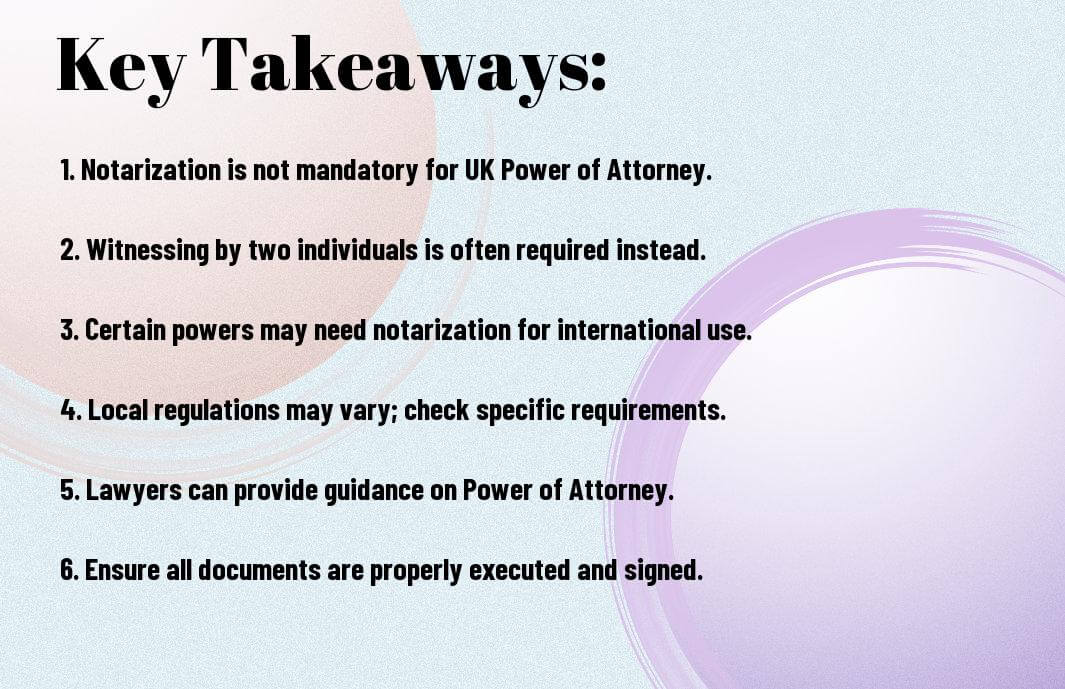
Key Takeaways:
- Not Required: A notary is not legally required for a Power of Attorney in the UK.
- Witness Signatures: Instead of a notary, the document must be signed in the presence of a witness who is not a family member.
- Specific Types: Certain types of Power of Attorney, such as lasting powers, may require additional steps for validity.
- Overseas Use: For a Power of Attorney to be used abroad, notarization may be needed depending on the country.
- Legal Advice: Seeking legal advice can clarify requirements and ensure the document suits your needs.
Understanding Power of Attorney
Before exploring the necessity of a notary for your power of attorney, it’s important to grasp what a power of attorney entails. This legal document allows you to appoint someone to act on your behalf in personal, medical, or financial matters when you cannot do so yourself.
Definition and Types
Along with the basic concept, there are several types of power of attorney to consider:
| Type | Description |
|---|---|
| General | Gives broad powers to the attorney-in-fact. |
| Limited | Specific powers for a defined purpose. |
| Durable | Remains effective even if you become incapacitated. |
| Springing | Takes effect only under certain conditions. |
| Health Care | Specifically for medical decision-making. |
- General
- Limited
- Durable
- Springing
- Health Care
Knowing the different types helps you select the right one for your needs.
Purpose and Importance
Importance lies in the fact that a power of attorney empowers you to plan for your future, ensuring that your wishes are respected when you can no longer advocate for yourself.
Understanding the purpose of a power of attorney is vital in safeguarding your interests. It allows you to designate a trusted person to manage your affairs, ensuring continuity in financial and medical decisions. By having a power of attorney in place, you maintain a degree of control, preventing potential disputes or complications when faced with incapacity. Ultimately, it provides you with peace of mind, knowing that someone you trust will handle your affairs according to your wishes.
Notarization in the UK
You may wonder about the necessity of notarization when creating a Power of Attorney in the UK. While it’s not always a requirement, understanding the role of a notary can help you assess its importance for your specific situation and ensure that your legal documents are recognized and enforceable. Notarization can add a layer of authenticity that might be beneficial in certain circumstances.
What is a Notary Public?
An individual appointed to serve the public as an impartial witness in legal matters is known as a Notary Public. They are responsible for verifying identities, witnessing signatures, and ensuring that documents are executed appropriately and within the law.
Role of Notaries in Legal Documents
Along with verifying identities, notaries play an important role in the execution of legal documents, such as Powers of Attorney, trust deeds, and property transactions.
Their main purpose is to prevent fraud by ensuring that the signatories are who they claim to be and fully understand the contents of the documents they are signing. By witnessing the signing of a document, notaries lend their official seal or signature, which can help affirm the document’s legitimacy and may be required by certain institutions or authorities. Engaging a notary can be particularly helpful if your Power of Attorney will be used in different jurisdictions or needs to meet strict legal standards for acceptance.
Do You Need a Notary for Power of Attorney?
All powers of attorney do not necessarily require notarization in the UK. However, having a notary can provide additional authentication, especially when dealing with international matters or foreign jurisdictions. While many situations will only need your signature, consulting a notary can give you peace of mind that your document meets legal standards.
Legal Requirements
Before creating a power of attorney, you should familiarize yourself with the specific legal requirements associated with it. Generally, a power of attorney in the UK must be signed by you and at least one witness, but notarization is only required in particular circumstances. Reviewing these necessities helps ensure that your document is valid and enforceable.
Situations Requiring Notarization
After creating a power of attorney, there are scenarios where notarization becomes important. If your document will be used abroad or in the context of international transactions, notarization is often required by foreign authorities or institutions. Understanding these conditions helps you prepare adequately for any legal obligations your power of attorney may entail.
But not all situations demand notarization. If you’re using your power of attorney solely within the UK, as long as it meets the basic legal criteria, you may not need a notary. However, if you anticipate any complexity or require recognition in multiple jurisdictions, consulting a notary might be beneficial to avoid potential complications later on.
Alternatives to Notary Services
Your options for executing a Power of Attorney in the UK extend beyond notary services. You can also consider alternatives such as local solicitors, who can offer guidance and ensure your documents are legally compliant. Additionally, depending on your situation, an official witness may suffice for the execution of your documents, eliminating the need for a notary altogether.
Witness Requirements
Beside using a notary, you may need a witness to validate your Power of Attorney. It is imperative that your chosen witness is impartial—meaning they should not be a family member or a beneficiary of your Power of Attorney. Having an independent witness present when you sign your document adds an extra layer of legitimacy.
Other Forms of Validation
Beside notary services, there are other avenues for formal validation of your Power of Attorney. These can include obtaining a solicitor’s certification or using specific forms designed for the task. You may also explore options like registering your Power of Attorney with the Office of the Public Guardian, which provides an official recognition of your authority.
Further, validating your Power of Attorney through these methods ensures that your document is recognized in your dealings, providing peace of mind. By exploring various validation options, you can find the method that best suits your needs while ensuring the legality of your Power of Attorney. This thorough approach supports your intentions and helps avoid any potential complications in the future.
Implications of Notarization
Not having your Power of Attorney notarized can lead to significant implications. While notarization is not a legal requirement in the UK, it can enhance the document’s credibility and serve as a safeguard against potential disputes. Without it, third parties may question the authenticity of the Power of Attorney, leading to complications in accepting and acting upon it.
Benefits of Notarized Power of Attorney
At its core, a notarized Power of Attorney provides you with peace of mind, ensuring that your document is recognized and respected by institutions and individuals. It adds a layer of legitimacy, making it easier for your appointed attorney to act on your behalf during critical situations. Additionally, it may help prevent fraud, as the notary verifies your identity and intentions during the signing process.
Risks of Not Having a Notary
To proceed without notarization can expose you to several risks regarding the validity and acceptance of your Power of Attorney. Without a notary’s endorsement, individuals or organizations might refuse to honor your document, complicating situations where immediate action is required. Furthermore, the lack of notarization can sometimes lead to challenges in court if disputes arise regarding the authority granted to your attorney.
Benefits of not having a notarized Power of Attorney can include potential cost savings and a simpler execution process. However, these advantages are often outweighed by the risks of complicated acceptance, disputes, and possible fraud. You could find yourself in a situation where your ability to have someone act on your behalf is severely restricted, making it critical to evaluate the importance of notarization for your specific needs.

Common Misconceptions
Now, many people hold misconceptions regarding the need for notarization when executing a Power of Attorney in the UK. Some believe that all legal documents must be notarized to be valid, while others think that the presence of a notary automatically suffices for a legally binding agreement. Understanding the specifics can greatly impact how you approach your legal documentation, so it’s vital to clarify these misunderstandings.
Myths about Notarization
Any discussion on notarization brings forth various myths, one being that notarization guarantees the validity of a Power of Attorney. In reality, while a notary can witness signatures, they cannot validate the content of the document or its legal consequences. This misconception may lead you to believe that notarization alone fulfills all legal requirements necessary for your Power of Attorney.
Clearing up Confusion
Clearing up confusion surrounding notarization is vital for ensuring that your Power of Attorney is valid and effective. Many assume that notarization is universally required in the UK, but this is not the case. The law varies across jurisdictions, and while certain documents may benefit from notarization, it’s important to understand that a Power of Attorney typically requires different forms of witness signatures to be enforceable. Thus, staying informed about your specific requirements is beneficial.
Common misunderstandings can lead to unnecessary complications when establishing your Power of Attorney. It’s vital to consult with a legal professional who can guide you on the best practices tailored to your situation. Understanding your specific requirements and clarifying misconceptions will help you ensure that your document is valid without unnecessary steps, like notarization, that may not be needed in your case.
Conclusion
Presently, you may not need a notary for your power of attorney in the UK, as long as it is properly signed and witnessed. However, if your document will be used abroad, or if you wish to ensure greater acceptance, having it notarized might be beneficial. Always check the specific requirements of the institution or authority that will be using the power of attorney to ensure compliance with their regulations.
Q: Is a notary required for a power of attorney in the UK?
A: In the UK, it is not mandatory to have a power of attorney (POA) document notarized. However, you may choose to have it notarized for added authenticity, especially if the document will be used abroad. Notarization can provide additional assurance to third parties regarding the validity of the signature and the identity of the individuals involved. It is advisable to check specific requirements if the POA is intended for use in another country.
Q: What types of power of attorney can benefit from notarization?
A: While not all power of attorney documents require notarization, certain types may benefit from it. For instance, if you are executing a lasting power of attorney (LPA) for financial matters or health care decisions and anticipate that it may be presented internationally, notarization can help prevent potential disputes about the document’s authenticity. Additionally, if the POA is intended for a specific financial institution or a governmental body, it might be worthwhile to inquire if they have specific notarization requirements.
Q: How do I get a power of attorney notarized in the UK?
A: To get a power of attorney notarized in the UK, first, ensure that the document is complete and signed by the appropriate parties. Then, locate a notary public who is registered and has the authority to notarize documents. You will need to present valid identification, and in some cases, the notary may require you to be in their presence while signing the document. The notary will then add their official seal and signature, confirming that they have witnessed the signing and verified your identity.


