
Notary

Notary Requirements for Immigration Applications

Notary requirements for immigration applications

With the complexities of immigration applications, understanding notary requirements is vital for ensuring the accuracy and validity of your documents. You may need to consider the role of notaries as they facilitate the proper execution of legal papers. Familiarize yourself with the specifics, including the difference between Notaries and Notarios Publicos, as they can vary in function. For more detailed information, check out this resource on Notaries, Notarios Publicos, and Immigration.

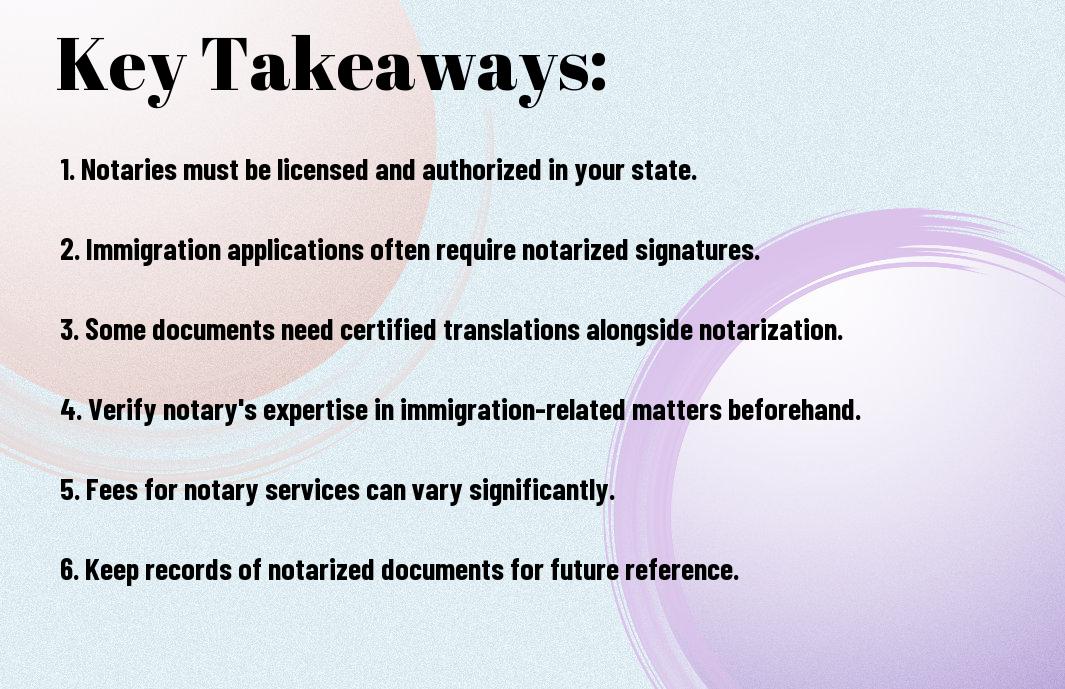
Key Takeaways:

  • Identification: Applicants must provide valid identification to the notary to authenticate their identity. This is important for the validity of the documents.
  • Signature Verification: Notaries are responsible for verifying the signatures on immigration documents to ensure they are completed properly before submission.
  • Notary Public Limitations: It’s important to understand that notaries cannot provide legal advice or represent applicants in immigration proceedings.
  • Document Types: Immigration applications may require various documents, such as affidavits and translations, which must be notarized correctly.
  • State-Specific Rules: Notary requirements can vary by state; therefore, applicants should check local regulations to ensure compliance.

Notary requirements for immigration applications

Overview of Notary Functions in Immigration

Your understanding of notary functions is vital when navigating the immigration process. Notaries play a significant role in verifying documents and facilitating the proper filing of immigration applications. They ensure that your paperwork is accurately completed and may help to prevent delays in your application due to errors. Knowing how notaries can assist you helps streamline your journey toward immigrant status.

Definition and Role of a Notary

Role of a notary includes acting as an impartial witness during the signing of documents. They verify the identity of individuals, administer oaths, and affirm the authenticity of signatures. In the context of immigration, notaries help ensure that your documents comply with legal standards, which can be vital for your application’s success.

Differences Between Notary Public and Immigration Attorney

Beside their functions, it’s important to distinguish between a notary public and an immigration attorney. While both can assist you, they serve different purposes. A notary public primarily verifies signatures and ensures that documents are executed correctly, whereas an immigration attorney provides legal advice, represents you in legal matters, and navigates the complexities of immigration law.

Definition of these differences highlights that immigration attorneys possess specialized training and are licensed to handle legal issues surrounding immigration matters. They can advocate for your case and offer personalized advice tailored to your specific situation. In contrast, notaries do not have the legal authority to provide such assistance, making the choice between the two significant based on your needs.
Notary requirements for immigration applications

Notary Requirements for Immigration Applications

The notary process plays a significant role in immigration applications, ensuring that your documents are duly authenticated. Most immigration authorities require you to submit notarized documents to validate your identity and provide an additional layer of credibility to your application. By adhering to notarial requirements, you enhance your chances of a successful application and smooth processing.

General Notarial Practices

Any notary public will guide you on general practices that ensure your documents meet legal standards. This typically involves verifying your identity, witnessing your signature, and administering an oath if required. It’s important to choose a notary well-versed in immigration-related matters, as this ensures your documents will be correctly handled and accepted by immigration authorities.

Specific Documentation Guidelines

Applications for immigration often require specific documentation that must be notarized. You should consult with your notary about which documents need to be completed following notarial protocols, including forms such as affidavits, declarations, and other supporting materials central to your case.

Understanding the specific documentation guidelines is vital for a smooth immigration process. Make sure you gather all required forms and any additional documents as specified by the immigration authorities. Different types of applications may require different sets of documents, so being precise and organized will help you avoid delays and potential issues with your application. Always check that your documents are fully completed, signed, and, most importantly, notarized according to the stringent requirements set forth for your immigration application.

Common Immigration Applications Requiring Notary Services

Many immigration applications necessitate notary services to authenticate documents and ensure compliance with legal standards. These applications often include family reunification petitions, employment-based visas, and adjustment of status requests, all of which require meticulous documentation. Maintaining accurate and notarized documents is imperative to avoid potential delays and complications in your application process.

Family-Based Immigration

On your journey towards family-based immigration, proper documentation is vital. You may need to submit forms like the I-130 Petitions for Alien Relatives, which often require notarized signatures and copies to validate your claims. Ensuring that all documentation is correctly notarized can help expedite the processing of your application and bring your family closer together.

Employment-Based Immigration

Before submitting your employment-based immigration application, it’s important to prepare your supporting documents accurately. Notarization of crucial documents such as job offers and labor certification can bolster your case and reflect professionalism in your application packet.

Notary services play an imperative role in your employment-based immigration process. Notarizing documents like Form I-140 (Immigrant Petition for Alien Worker) ensures that all signatures and statements are legally valid. This step helps prevent potential issues with the U.S. Citizenship and Immigration Services (USCIS) that could arise from improperly signed documents. By employing notary services, you can enhance the credibility of your application and increase your chances of a favorable outcome.

Validating Notary Certificates

All immigration applications often require notarized documents, making it necessary to validate notary certificates accurately. A validated notary certificate verifies that the notary public has fulfilled their duties correctly and can help strengthen your application. This process minimizes the risk of setbacks and enhances the credibility of your submitted documents in the eyes of immigration authorities.

Importance of Proper Notary Acknowledgment

Any error in the notary acknowledgment can lead to complications and potential rejection of your application. A properly executed acknowledgment confirms the authenticity of your signature and the intent behind the documentation. Ensuring that the notary’s acknowledgment is complete and correctly filled out safeguards your application process.

Checking Notary Credentials and Authority

Validating the credentials and authority of your notary is necessary for a smooth immigration process. You need to ensure that the notary is licensed, has the proper jurisdiction, and is in good standing within their state. An unauthorized or improperly connected notary can jeopardize the validity of your documents, leading to unnecessary delays.

Notary public appointments can vary by state, so it’s important for you to confirm that your notary has the legal authority to notarize documents in your jurisdiction. You can verify their status through state licensing boards or government websites. Some states even provide databases where you can check the notary’s credentials and ascertain their active status. Taking these steps ensures that your notarized document is legitimate and helps you avoid complications with your immigration application.

Potential Consequences of Improper Notarization

Once again, ensuring proper notarization is vital for your immigration applications. Failing to adhere to notary requirements can lead to significant complications that may jeopardize your case. Any discrepancies or errors in notarization can raise red flags for immigration officials, potentially undermining the credibility of your documents and application.

Application Delays

On multiple occasions, improper notarization can result in unexpected application delays. If documentation is not adequately notarized, the reviewing immigration authority may require additional verification or even return your application for corrections, extending your waiting time unnecessarily.

Risks of Fraud and Legal Issues

Below, you should be aware that improper notarization poses serious risks of fraud and legal issues. Notarized documents are expected to be genuine and reliable; any evidence of tampering or forgery could lead to severe penalties, including possible removal proceedings.

Plus, the implications of such risks can extend beyond your current immigration application. If found guilty of submission of fraudulent documents, you may face legal consequences that could affect future attempts at immigration or even result in criminal charges. Upholding the integrity of your documents not only strengthens your application but also protects you from potential legal pitfalls.

Resources for Finding Notary Services

Despite the importance of finding reliable notary services for your immigration applications, it can often be overwhelming. Thankfully, several resources are available to aid you in your search. Local community centers may offer notary assistance or can connect you with qualified professionals. Additionally, online directories can help you identify notaries in your area. Be sure to consider reviews and recommendations when selecting a notary to ensure you receive the best service possible.

State Licensing Boards

Services provided by notaries can vary, so it’s beneficial to consult your state’s licensing board. Each state has regulations that notaries must adhere to, and you can typically find a list of licensed notaries on their official website. This ensures you select a notary who is compliant with state laws and procedures, ultimately providing peace of mind as you navigate your immigration application.

Professional Notary Associations

Below are valuable tools for finding notaries: professional associations often maintain directories that include certified notaries in your area. These organizations provide resources for both notaries and clients, helping you make informed choices as you pursue your immigration goals.

And these professional notary associations also offer additional services, such as training and certification programs for notaries, ensuring they stay updated on regulations and best practices. By choosing a notary affiliated with a reputable association, you can boost your confidence in their expertise and professionalism. This connection can lead to a more efficient and accurate completion of your immigration application.

To wrap up

Now that you understand the notary requirements for immigration applications, you can ensure that your documents are properly prepared and authenticated. It’s vital to verify that any notary you choose is licensed and familiar with the specific immigration documentation you need. Keeping your records organized can streamline the process and prevent delays in your application. By following these guidelines, you enhance your chances of a successful immigration journey.

FAQ

Q: What types of documents typically require notarization for immigration applications?

A: Immigration applications may require notarized documents such as affidavits, personal statements, or declarations that provide evidence supporting the applicant’s case. Additionally, documents that prove identity, relationship to family members, and any other supporting documents may also need to be notarized to ensure their authenticity and validity in the application process.

Q: Who is eligible to serve as a notary for immigration-related documents?

A: In the United States, a notary public must be officially appointed by the state, which includes passing a background check and completing any required training or education. Notaries can be lawyers, clerks, or individuals from various professions that have met their state’s requirements. However, it is important to ensure that the notary has experience with legal documents related to immigration, as they should understand the specific requirements and potential implications for the application being submitted.

Q: What should I consider when selecting a notary for my immigration documents?

A: When dicking out a notary for immigration documents, consider their experience with immigration cases, as they will be more familiar with the necessary documentation. It’s also wise to confirm their credentials and ensure they are licensed and in good standing within their state. Additionally, inquire about their processing times and fees to avoid any unexpected issues or delays in your application submission.

Why You Might Need a Notary for Your Business Contracts

Do you need a notary for contracts

Most business owners overlook the importance of a notary when it comes to contracts, but having one can protect your interests and enhance the validity of your agreements. A notary public ensures that the parties involved have signed the documents willingly and are who they claim to be, which can prevent disputes down the line. This post will explore the reasons why enlisting a notary might be beneficial for your business contracts and how it can safeguard your transactions.

Do you need a notary for contracts

Key Takeaways:

  • Validation: A notary public provides official verification of signatures on contracts, ensuring the parties’ identities are confirmed.
  • Deterrent: The presence of a notary can reduce the likelihood of disputes, as it demonstrates a commitment to the authenticity of the agreement.
  • Legality: Some contracts, especially in certain industries, may be legally required to be notarized to be considered valid.
  • Record Keeping: Notaries maintain reliable records of transactions, which can be helpful in case of future legal issues or audits.
  • Protection: Notarization helps protect your business interests by verifying that the agreement was entered into freely and without coercion.

The Role of a Notary in Business Contracts

Before entering a business contract, understanding the role of a notary can provide clarity and assurance. Notaries serve as impartial witnesses to the signing of documents, ensuring that the parties involved understand the terms and willingly agree to them. This added layer of verification can help prevent disputes and protect your interests, giving your contracts a more robust legal standing.

Definition and Importance of Notarization

Around business transactions, notarization is the process by which a notary public verifies the authenticity of signatures and the identity of the signatories. This process is necessary as it adds credibility to your documents, making them more trustworthy in the eyes of stakeholders and legal authorities.

Common Services Provided by Notaries

Notarization typically covers a range of services vital for business operations, including the attestation of documents, verification of signatures, and administering oaths. These functions ensure that your contracts and agreements are properly executed and can withstand potential legal scrutiny.

In fact, many notaries also offer additional services such as drafting simple legal documents, providing copies of notarized documents, and offering guidance on record-keeping. By utilizing these services, you can ensure that your business’s contractual agreements are not only legally compliant but also carry the weight necessary to support your interests effectively.

Do you need a notary for contracts

Legal Validity and Enforceability

If you’re entering into a business contract, ensuring its legal validity and enforceability is important for protecting your interests. By having a notary, you provide an extra layer of authenticity that reassures all parties involved. This notarization verifies the identities of those signing the agreement and confirms their willingness to enter into the contract, thus preventing claims of coercion or misunderstanding in the future.

How Notarization Enhances Contract Validity

For business owners, notarization serves as an important step in strengthening the legitimacy of your contracts. A notary’s signature and seal act as a guarantee that the document was signed in the presence of an authorized official, ensuring that all parties are who they claim to be and that they have willingly signed the agreement.

Avoiding Legal Disputes

Above all, having your contracts notarized can significantly lower the risk of future legal disputes. The notarial process creates a record that can be referred to if disagreements arise, providing critical evidence that can support your position should you need to take legal action.

In addition, the presence of a notary can deter any potential claims of fraud or misrepresentation, as the notary serves as an impartial witness to the signing process. This added transparency can prevent misunderstandings that may lead to disputes, helping you maintain a more harmonious business relationship with your partners. By taking this extra step, you importantly safeguard your business from unnecessary legal battles, allowing you to focus on growth and success.

Protecting Against Fraud

Now that you are engaging in business contracts, it’s important to consider how a notary can help you protect against fraud. A notary serves as an impartial witness during the signing process, which adds a layer of authenticity to your agreements. By ensuring all parties are who they claim to be and understanding the terms they are signing, you can significantly reduce the risk of fraudulent activities. To explore further, check out the Top 6 Reasons to Use a Notary Signing Company.

Identity Verification

About ensuring your contracts are enforceable involves the process of identity verification. A notary verifies the identity of each signer through government-issued identification, confirming that the individuals are who they say they are. This step not only enhances the credibility of your agreements but also deters potential fraudsters.

Preventing Business Scams

Beside the importance of identity verification, preventing business scams is a key benefit of employing a notary for your contracts. By having a third-party witness, you establish a documented process that can help safeguard your business against deceptive practices and false claims.

Understanding the methods employed by fraudsters can help you further protect your business. Scams can come in various forms, often targeting contracts and agreements for unauthorized gains. By involving a notary, you create a standardized procedure for verifying identities and validating contracts, thus making it significantly harder for scammers to exploit vulnerabilities in your business dealings.

Special Situations Requiring Notarization

All business contracts may benefit from notarization, but certain situations demand it. Notarization provides an additional layer of security and verification that your documents are authentic and that parties involved have willingly agreed to the terms. This is particularly important when entering into binding agreements or when significant assets are involved. Understanding when notarization is required can help protect your business interests and mitigate potential disputes in the future.

Real Estate Transactions

Among the most notable situations that require notarization are real estate transactions. These agreements typically involve large sums of money and require strict adherence to local laws. Notarizing these documents not only helps confirm the identities of the parties involved but also ensures that all terms are agreed upon and documented in a legally binding manner.

Power of Attorney Documents

Real estate transactions are not the only situations that necessitate notarization; power of attorney documents also fall into this category. These documents grant someone the authority to act on your behalf in legal matters, making it imperative to have them notarized for validation.

Hence, when it comes to power of attorney documents, having them notarized adds a vital layer of legitimacy. This process confirms that you are willingly assigning your decision-making authority to another individual, ensuring that your intentions are clear and legally recognized. Without notarization, these documents may not hold up in court, which can lead to complications when you need someone to act on your behalf. Ensure your power of attorney is properly notarized to secure its validity and your peace of mind.

Choosing the Right Notary for Your Business

Once again, selecting a notary for your business requires careful consideration. You should look for a notary who specializes in business contracts and has experience in your industry. It’s advisable to review their qualifications and read testimonials. For further insights on how notaries can elevate your contracts, check out The Power of a Notary: Why Your Contracts Might Need It.

Types of Notaries

Among the types of notaries you may encounter are:

Traditional Notary Handles basic notarizations
Online Notary Provides remote notarizations via video
Mobile Notary Travels to your location for notarization
Specialty Notary Focuses on specific fields like real estate
Attorney Notary A notary who is also a licensed attorney

After determining the type you need, it’s important to assess their availability and fees.

Considerations for Selection

Around your selection process, consider factors such as the notary’s location, experience, and specialization relevant to your business needs. A well-chosen notary will provide you with peace of mind, knowing that your documents are certified and legally binding.

Considering these aspects will help ensure you choose a notary who aligns with your business requirements. Evaluate their communication skills, reliability, and customer service quality to guarantee a smooth notarization experience. Taking the extra time to vet your notary will lead to better transactional efficiency and legal compliance for your business.

Costs and Fees Associated with Notarization

Many business owners may overlook the costs associated with notarization, but understanding these fees is important for your financial planning. The fees can vary depending on the type of document, the complexity of the transaction, and your geographic location. Some notaries charge a flat fee for standard services, while others may charge based on the number of signatures or additional services like travel. Keeping an eye on these costs can help you make informed decisions about your notary needs.

Understanding Pricing Structures

Around the country, notary fees can fluctuate depending on state regulations and individual notary practices. Many states have set maximum fees for specific services, and some notaries may offer discounted rates for recurring clients or bulk services. It’s important to research the fees applicable in your area to anticipate your budget effectively.

Budgeting for Notary Services

Structures that include notary services in your business budget can help you avoid unexpected expenses. By allocating a specific portion of your operational costs to notary services, you will be better equipped to manage these fees as they arise. This proactive approach allows you to ensure that notary services do not disrupt your cash flow, allowing for smoother business operations.

Considering the various factors that influence notarization costs, it is advisable to factor in both regular and occasional notary services when creating your budget. This includes one-time contracts, recurring agreements, and potential emergency notarization needs. By understanding your business’s specific requirements, you can effectively plan for these expenses and ensure that you have the resources to cover them when needed.

Summing up

Taking this into account, having a notary for your business contracts can significantly enhance the legality and trustworthiness of your agreements. A notary serves to verify the identities of all parties, ensuring that documents are executed willingly and without coercion. This process can protect you and your business from potential disputes and fraud, offering an added layer of security. By utilizing notarization, you reinforce the authenticity of your contracts, making it easier to resolve conflicts and uphold your rights. Ultimately, engaging a notary can be a wise investment in the integrity of your business dealings.

FAQ

Q: Why is having a notary important for business contracts?

A: A notary public serves as an impartial witness during the signing of business contracts. Their role is to verify the identities of the signers, ensuring that they are who they claim to be and that they are signing the document voluntarily. This added layer of authentication can help protect against fraud and ensure the enforceability of the contract in legal situations.

Q: What types of business contracts typically require notarization?

A: Notarization is often required for a variety of business contracts, including but not limited to property transfers, loan agreements, partnership agreements, and certain types of leases. While not all contracts require notarization by law, having a notary involved can lend credibility to the document and may be a requirement based on the agreement’s specific circumstances or industry standards.

Q: How does notarization affect the legal standing of a business contract?

A: Notarization can enhance the legal standing of a business contract by providing an official record of the signing process. If a dispute arises, a notary’s acknowledgment can serve as evidence that the parties were properly identified and that they entered into the agreement willingly. This can be particularly important in any legal proceedings, as it adds a layer of legitimacy and reliability to the contract.

The Evolution of Notary Services in the UK – Past, Present, and Future

The evolution of notary services in the uk

You may not realize how significantly notary services have evolved in the UK over the years. From their origins steeped in medieval tradition to modern digital practices, notaries have adapted to meet the demands of a changing society. In this blog post, you’ll explore the key milestones in the history of notary services, understand their current role in legal and business matters, and gain insight into future trends that may reshape this vital profession. Join us on a journey through time to see how notaries continue to play an important role in our everyday lives.

Key Takeaways:

  • Historical Context: Notary services in the UK have a rich history, evolving from simple document verification to an imperative part of legal processes.
  • Modernization: The current digital age has led to advancements such as online notary services, making the process more accessible and efficient.
  • Regulatory Changes: Recent reforms aim to enhance the professionalism and integrity of notarial practices, ensuring trust in the services provided.
  • International Influence: Globalization has impacted notary practices in the UK, with a growing need for cross-border services among different legal systems.
  • Future Trends: The future of notary services may include increased automation and integration of technology to meet evolving consumer needs.

Historical Overview of Notary Services

Before the establishment of modern regulations, notary services in the UK had a rich history rooted in the need for legal documentation and authentication. As society evolved, so did the roles and responsibilities of notaries, adapting to the demands of changing legal and business landscapes. Understanding this history provides valuable context for how notary services function today.

Origins of Notary Services in the UK

Services that resembled notary functions date back to ancient civilisations, but in the UK, they began to take shape during the medieval period. Notaries were initially clerics or members of the Church, facilitating transactions and ensuring that documents were accurately recorded. These early notaries played an vital role in commercial activities and legal matters.

Development Through the Ages

Across the centuries, notary services evolved significantly, reflecting broader societal changes. Originally, notaries operated mostly within ecclesiastical courts, but by the Renaissance, their responsibilities expanded to encompass a wider array of transactions and documentations. The emergence of trade agreements and the rise of commerce during this period fueled the need for reliable documentation, prompting the formal recognition of notaries as legal professionals.

Hence, the development of notary services through the ages highlights the necessity for trustworthy documentation in an increasingly complex society. As trade expanded and legal systems became more intricate, notaries adapted by honing their skills in drafting and authenticating documents, solidifying their position as key players in the legal landscape. By the time the Notaries Act of 1801 was enacted, notaries had established a clear role in law and commerce, setting a precedent for the notarial services you rely on today.

The evolution of notary services in the uk

The Role of Notaries in Modern Society

If you think of notaries merely as witnesses to signatures, it’s time to reconsider. Notaries serve as vital intermediaries in your legal and business transactions, ensuring the authenticity of documents and safeguarding against fraud. Their unique position in society allows them to facilitate international dealings, uphold legal frameworks, and provide specialized services tailored to the growing complexities of modern life.

Current Functions and Responsibilities

With a focus on verification and authentication, today’s notaries perform a range of functions, including preparing and certifying documents, administering oaths, and providing legal advice on various matters. You can rely on notaries to help with estate planning, business transactions, and international agreements, ensuring that your documents hold up under scrutiny.

Regulations Governing Notary Practices

After you engage a notary, it’s vital to understand that their services fall under strict regulations and oversight to maintain integrity and public trust. This framework ensures that notaries adhere to high professional standards and remain accountable for their actions.

Plus, these regulations are designed to protect you as a client, outlining the qualifications and ethical practices a notary must uphold. In the UK, notaries are typically governed by the Notaries Act of 1815 and regulated by both the Faculty Office and the Notaries Society. These bodies not only mandate rigorous training but also enforce continuing education and professional conduct, ensuring that notaries remain qualified to assist you in a rapidly changing legal landscape.

Technological Advancements and Notary Services

Once again, the landscape of notary services is being reshaped by technological advancements. Emerging technologies, including artificial intelligence and blockchain, have streamlined various processes and improved efficiency. As you engage with notarial services, it’s vital to understand how these innovations can enhance your experience, making transactions more reliable and secure.

Digital Notarization and E-Notaries

An increasing number of notaries are now offering digital notarization services, allowing you to sign and validate documents online. This shift not only saves time but also expands access, enabling remote transactions that cater to your busy lifestyle. With e-notaries, you can complete vital paperwork without the complications of travel or waiting.

The Impact of Technology on Traditional Practices

Against a backdrop of rapid technological change, traditional notary practices are evolving. The integration of electronic tools in notarization processes challenges longstanding methods, prompting you to adapt to new practices that foster efficiency while maintaining legal security.

Traditional notary practices often relied heavily on face-to-face interactions and paper documents, creating time-consuming processes. In contrast, technology allows you to engage in notarization seamlessly, whether from your home or office. You’ll benefit from improved access and flexibility, as digital collaboration tools and secure document-sharing platforms enable you to complete your notary needs without interruption. This shift not only enhances efficiency but also maintains the integrity and security of the notarization process, proving that modern advancements can coexist with age-old traditions.

Challenges Facing Notary Services Today

Despite the longstanding importance of notary services in the UK, today’s landscape presents various challenges. Increased digitalization, evolving client expectations, and stringent regulatory requirements put pressure on notaries to adapt and innovate. The need for enhanced efficiency while maintaining credibility is paramount, as you navigate these complexities in a rapidly shifting environment.

Legal and Ethical Considerations

Today, you must remain vigilant regarding legal and ethical considerations in notary services. Compliance with various regulations ensures that you uphold integrity and public trust in your profession. Balancing your duties while adhering to these legal frameworks is crucial to safeguarding your reputation and that of the notary profession as a whole.

Competition from Alternative Services

Across the sector, you face stiff competition from alternative services that offer similar document verification options. Innovations such as online notarization and automated platforms create a challenge for traditional notary services to maintain their client base.

Also, the rise of digital platforms and online services has transformed the notary landscape, presenting both challenges and opportunities for your practice. Many clients now opt for faster, more convenient alternatives that digital services provide, often compromising personal interaction for efficiency. To remain relevant and competitive, you will need to consider integrating technology into your services while emphasizing the personalized support and expertise that only you can provide. Building a strong online presence and adapting to these changing demands will be crucial for sustaining your notary practice moving forward.

The evolution of notary services in the uk

The Future of Notary Services in the UK

Unlike traditional practices, the future of notary services in the UK will likely be shaped by technology and evolving consumer needs. As digital transformations occur, you can expect notarial services to become more accessible and streamlined. Innovations in online document authentication, remote notarisation, and secure digital signatures will redefine the landscape, allowing you to complete notarial processes more efficiently while maintaining high standards of security and compliance.

Predictions for the Next Decade

Below, you’ll find insights into what you might anticipate in notary services over the next ten years. With the adoption of advanced technologies and an increased focus on client convenience, notary services could see enhanced accessibility and efficiency. Embracing online platforms and digital verification will transform how you interact with notaries.

The Evolving Legal Landscape

After a thorough look at the current trends, you may notice a shift towards a more digitised and interconnected legal environment. The processes in which you engage with notaries will be influenced by changes in legislation and greater global connectivity. Increased collaboration among legal professionals will enhance the overall experience for clients, streamlining procedures on various fronts.

Predictions indicate that the evolving legal landscape will necessitate continuous adaptability among notary services. You can expect stronger regulatory frameworks and potential new guidelines that govern how notaries operate in a digital-first world. This transformation will ensure you have access to secure and efficient services tailored to meet your modern needs, fostering trust and reliability in your transactions.

Global Perspectives on Notary Services

After examining the evolution of notary services in the UK, it’s necessary to consider how these practices compare globally. Notaries across the world fulfill similar roles, but each country’s regulations and processes may differ significantly, shaping how you utilize notary services in your own jurisdiction.

Comparison with International Practices

At the international level, notary services vary widely in scope and authority. The following table illustrates key differences:

International Notary Practices

Country Regulations and Powers
USA State-specific regulations; limited authority.
France Notaries have extensive legal powers; trusted for complex transactions.
Germany Highly regulated; responsibility for document authenticity.
Japan Involvement in property and corporate transactions; judicial functions integrated.

Lessons from Other Countries

The global landscape provides valuable insights into enhancing notary services in the UK. You can learn from effective practices elsewhere that promote efficiency, security, and accessibility, setting a more user-centric approach for notary services.

Considering the lessons from various countries, it becomes clear that embracing a more standardized and user-friendly framework could significantly improve your experience with notary services. By examining successful models from nations like France and Germany, you can advocate for reforms that streamline processes, boost trust, and ensure you receive the highest quality service tailored to your needs.

To wrap up

So, as you reflect on the evolution of notary services in the UK, you can appreciate how they have adapted to changing legal landscapes and technological advancements. The journey from traditional roles to modern practices highlights the importance of notaries in safeguarding your transactions today and in the future. For a deeper understanding, you may want to explore this Short History of the Notary Public. Your awareness of these developments will empower you to navigate your legal needs with confidence.

FAQ

Q: How have traditional notary services in the UK changed over the decades?

A: Traditional notary services in the UK have undergone significant changes over the decades, adapting to advancements in technology and shifts in societal needs. Historically, notaries primarily focused on witnessing signatures and authenticating documents. However, with the rise of digital communication and electronic transactions, many services have transitioned to offering online notarization. This evolution has enabled notaries to provide more efficient services while catering to a diverse clientele that values convenience and speed.

Q: What role does technology play in the current state of notary services in the UK?

A: Technology plays a transformative role in the current state of notary services in the UK. The introduction of digital tools allows notaries to remotely conduct meetings, verify identities through secure online platforms, and manage document signings efficiently. Electronic notary services have emerged, facilitating rapid processing times while maintaining security and compliance with legal standards. This technological advancement has not only expanded access to services but has also streamlined workloads, contributing to a more dynamic environment for notary services.

Q: What can we expect for the future of notary services in the UK?

A: The future of notary services in the UK is likely to be characterized by continued digital innovation and further integration of artificial intelligence. As regulations evolve to accommodate technological changes, we may see an expansion of services including automated verification processes and enhanced cybersecurity measures. Additionally, as remote work becomes more prevalent, the demand for online notary services is expected to grow. This progression will create new opportunities for notaries to adapt and offer more flexible solutions to meet the needs of clients in an increasingly digital world.

Skip to content