UK

The Process of Legalising Documents in the UK

Legalising your documents in the UK is an crucial step, especially when you need to use them for international purposes. Understanding the requirements and steps involved in this process can save you time and ensure your documents are accepted abroad. Whether you’re dealing with a birth certificate, marriage certificate, or any other official paper, knowing how to navigate the legalisation process will empower you to handle your paperwork efficiently. In this guide, you will learn the key stages and tips for successfully legalising your documents in the UK.

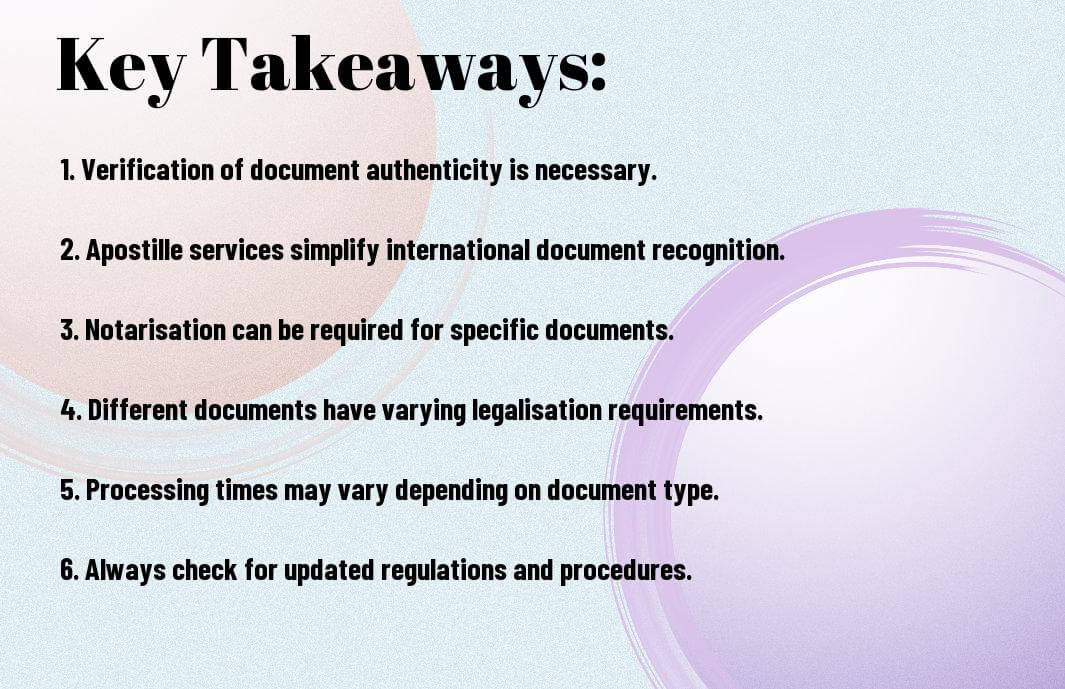
Key Takeaways:

  • Verification: Ensure documents are verified by a qualified authority, such as a solicitor, who can confirm their authenticity.
  • Legalisation: Understand the process of legalisation through the Foreign, Commonwealth & Development Office (FCDO), which may require additional steps for foreign use.
  • Apostille: Familiarize yourself with the Apostille stamp, which is used to certify the authenticity of documents intended for use abroad.
  • Fees: Be aware of applicable fees for document legalisation, as these can vary depending on the type and number of documents.
  • Processing Time: Plan for the processing time needed for legalisation, as this may affect the urgency of your documentation needs.

Understanding Document Legalisation

To navigate international borders and legal frameworks, understanding document legalisation is vital. This process involves verifying the authenticity of your documents so they are accepted in countries outside the UK. It ensures that the governmental authorities in the foreign country recognize your documents, allowing you to conduct business, study, or reside abroad.

What is Document Legalisation?

Understanding document legalisation involves recognizing it as a formal process that certifies the legitimacy of documents for international use. This typically includes notarization and the Apostille process, which confirm that your documents meet the required legal standards and are duly acknowledged by the relevant authorities.

Importance of Legalisation in the UK

Besides facilitating international transactions and agreements, legalisation in the UK protects your interests while ensuring compliance with foreign legal requirements. Failure to legalise your documents can result in wasted time, financial loss, or refusal of services, making the process paramount for anyone intending to operate globally.

With the globalisation of trade, the importance of legalisation in the UK cannot be overstated. It enhances the credibility of your documents, whether for employment, education, or legal matters, ensuring they are valid and accepted overseas. Legalisation not only affirms the authenticity of your credentials but also smooths the path for you in various international pursuits, safeguarding against potential legal issues that might arise from unrecognised documents.
The Legalisation Process in the UK

You must understand that the legalisation process in the UK involves several key steps to ensure that your documents are recognised abroad. This process is necessary for documents such as certificates, diplomas, and contracts that require validation by foreign authorities. The goal is to confirm the authenticity of your documents so they can be used legally in another country.

Steps Involved in Legalising Documents

An important step in legalising your documents is obtaining an official signature from a recognised authority, typically a solicitor or notary public. Following this, you will need to submit your documents to the Foreign, Commonwealth & Development Office (FCDO) to receive an apostille, which verifies the signature and serves as proof of authenticity.

Common Documents Requiring Legalisation

Legalisation is often required for various documents, including birth certificates, marriage certificates, academic diplomas, and power of attorney forms. These documents are typically necessary for international marriages, job applications, and business transactions.

The importance of legalisation extends to ensuring that your documents meet the specific requirements of the foreign country’s legal systems. This means you may need to check whether additional regulations apply based on the nature of your documents and the destination country, thereby safeguarding your interests during international dealings.

The Role of Notaries Public

Despite the importance of legalising documents in the UK, many individuals overlook the role of Notaries Public. These certified professionals serve as impartial witnesses in the signing of documents and ensure that the paperwork meets the required legal standards. For more details on the Legalisation of documents | Student Administration, understanding their function is vital for a smooth legal process.

Definition and Responsibilities

Above all, Notaries Public are licensed legal practitioners who specialise in non-contentious matters, providing an array of services such as verifying identities, witnessing signatures, and certifying documents. Their responsibilities also extend to providing authentication for documents intended for use abroad, ensuring they comply with the relevant laws and regulations.

Choosing a Notary Public in the UK

An vital step in your document legalisation journey is selecting the right Notary Public for your needs. It’s vital to choose a qualified professional with the necessary expertise to handle your specific document requirements effectively.

With numerous Notaries Public available across the UK, you should consider their qualifications, experience, and reputation in the field. Conduct online research to find reviews or testimonials and verify their credentials through professional bodies. Additionally, it’s advisable to confirm that they offer services for the specific type of document you need to be legalised, as this ensures they have the relevant experience to meet your requirements accurately. Selecting the right Notary can significantly streamline the legalisation process for you.

Apostille Certificates

All documents intended for use in foreign countries may require an Apostille certificate. This certificate serves as a verification of the document’s authenticity and denotes that it has been notarised in the UK. Ensuring you have an Apostille can streamline the process of having your documents recognised abroad, making it necessary when dealing with international legal matters.

What is an Apostille?

For documents to be recognised internationally, an Apostille is necessary. This is a form of authentication issued under the Hague Convention, confirming that the signature, stamp, or seal on your document is genuine. With an Apostille, you can present your documents with confidence in countries that are part of this agreement.

How to Obtain an Apostille in the UK

By applying for an Apostille through the UK Foreign, Commonwealth & Development Office (FCDO), you can easily authenticate your documents. You will need to submit the original document along with a request form and the applicable fee. Processing typically takes a few days, ensuring your documents are ready for international use swiftly.

Certificates eligible for Apostille include official documents such as birth and marriage certificates, court documents, and academic qualifications. To obtain an Apostille, you should first ensure your document has been notarised if required, then fill out the request form available on the FCDO website. After that, send your documentation along with payment to the designated address. You can also explore the option of using an expedited service if you need your Apostille in a shorter timeframe.

Legalisation for International Use

Keep in mind that legalising your documents for international use involves several steps to ensure they are recognised abroad. The process typically includes obtaining an apostille or consular authentication, depending on the destination country’s requirements. Furthermore, it is necessary to verify the specific documentation needed for the purpose you intend to use the documents for, as different countries have varying rules.

Understanding Different Countries’ Requirements

Against the backdrop of diverse international laws, it’s vital to understand that each country has its own requirements for document legalisation. Before you proceed, research the specific criteria of the country where your documents will be used, which may include language translation, notarisation, and additional certifications.

Ensuring Compliance with Foreign Regulations

Any attempt to legalise your documents must account for foreign regulations to avoid rejection or complications. This means that you’ll need to thoroughly check these regulations to ensure that all your documents meet the specific conditions set forth by the destination country.

International legalisation involves navigating complex regulations, which can vary significantly between countries. You should consult with the appropriate authorities or legal experts to ensure your documents comply with specific foreign regulations. This may include adapting documents to local laws, obtaining notarisation, or even translating documents into the required language. By being thorough and diligent in this process, you enhance the chances of your documentation being accepted without issues abroad.

Common Challenges in the Legalisation Process

Not all aspects of the legalisation process go smoothly; you may face various challenges that can lead to confusion or delays. Understanding these common hurdles can help you navigate the process more effectively and ensure your documents meet the necessary legal requirements. It’s crucial to be aware of potential issues to mitigate their impact on your experience.

Delays and Errors

Below are some common reasons for delays and errors during the legalisation of documents. Incomplete documentation, incorrect fees, or miscommunications can lead to significant setbacks. If you are unprepared, you might find yourself waiting longer than anticipated or facing rejections, making it vital to double-check all submissions for accuracy and completeness.

How to Avoid Common Pitfalls

Challenges in the legalisation process can be effectively tackled with proper preparation and awareness. You can avoid pitfalls by thoroughly researching the specific requirements for your documents, ensuring you gather all necessary supporting materials, and verifying the accuracy of your information before submission.

Process adherence is your best ally when navigating the legalisation journey. Keep a checklist of all required documents and their specific legalisation steps. Make sure to stay updated on processing times and use reliable channels for submission. Being proactive in addressing potential issues will save you time, reduce stress, and ensure your documents are legalized without unnecessary complications.

To wrap up

From above, you can see that the process of legalizing documents in the UK involves a series of steps that ensure your documents are officially recognized. By understanding the requirements and procedures, you can streamline your experience and avoid potential pitfalls. For a comprehensive guide, you can refer to Legalization and Authentication of Documents in the UK. This knowledge empowers you to navigate the legal landscape with confidence.

Q: What is the first step in the process of legalising documents in the UK?

A: The initial step in the process of legalising documents is to ensure that your documents are properly certified. This means they must be issued by the relevant authority, such as a solicitor, notary public, or government department. Once the documents are certified, you can proceed to have them legalised by the Foreign, Commonwealth & Development Office (FCDO) or the appropriate embassy or consulate if the documents are intended for use abroad.

Q: What types of documents typically require legalisation in the UK?

A: Various types of documents may require legalisation depending on their intended use. Common examples include educational certificates, marriage certificates, powers of attorney, company documents, and personal identification papers. Certain countries may have specific requirements, so it’s important to check the legalisation needs for the country where the documents will be presented.

Q: How long does the legalisation process take in the UK?

A: The duration of the legalisation process can vary based on several factors, including the type of document and the current workload of the legalisation office. Generally, the process can take anywhere from a few days to a few weeks. It is advisable to plan ahead and submit your documents as early as possible to avoid delays, especially if you have a deadline for use in another country.

What Is a Certified Copy, and When Is It Required in the UK

Copying important documents is a common practice, but understanding the difference between a regular copy and a certified copy is vital for your legal and administrative needs. A certified copy is an official duplicate of an original document, verified as a true and accurate representation. In the UK, certain situations necessitate the use of certified copies, such as applying for a passport, loan agreements, or court proceedings. This blog post will guide you through what certified copies are, when they’re needed, and how to obtain them.

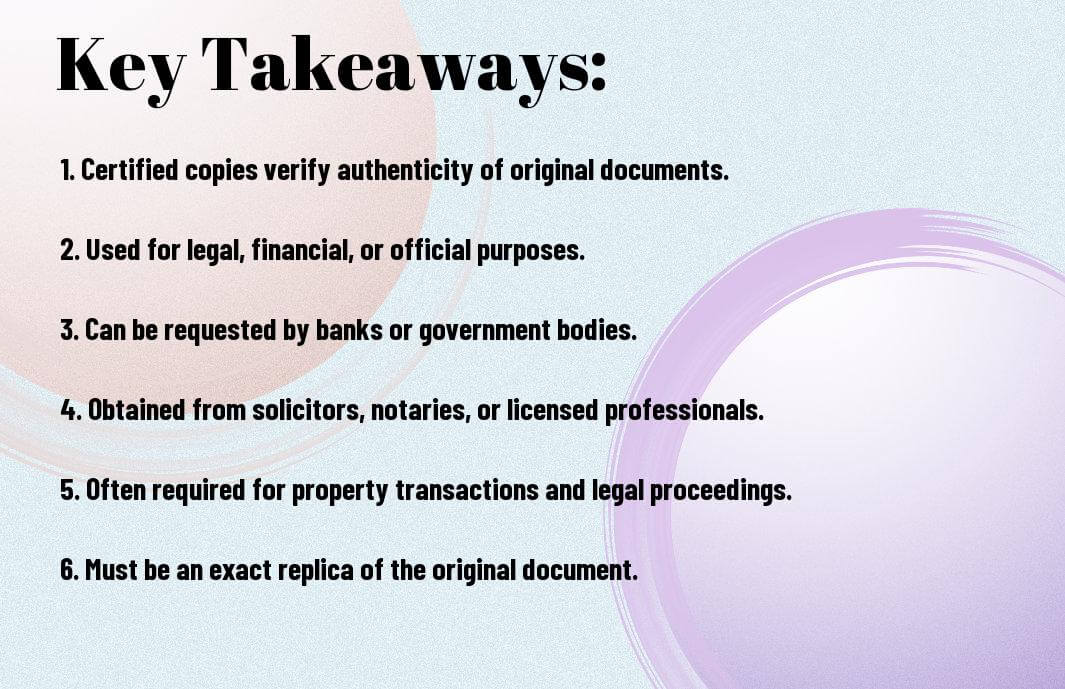
Key Takeaways:

  • Definition: A certified copy is an official reproduction of a document that has been verified as a true and accurate representation of the original by a qualified individual or authority.
  • Use Cases: Certified copies are often required for legal processes, including property transactions, court proceedings, or when submitting documents to government agencies.
  • Who Can Certify: Only specific professionals such as solicitors, notaries, or certain public sector officers are authorized to provide certified copies in the UK.
  • Identification: When obtaining a certified copy, individuals may need to show identification to confirm their identity and connection to the original document.
  • Validity: The certification process ensures that the copy is legally valid for official purposes and carries the same weight as the original document.

Definition of a Certified Copy

To put it simply, a certified copy is a duplicate of an original document, verified as a true and complete reproduction by a qualified individual or authority. This process ensures that the information contained in the copy accurately reflects the data in the original document, providing authenticity and reliability when required for various legal and administrative purposes in the UK.

Explanation of a Certified Copy

An important aspect of a certified copy is that it must be created from the original document, and the person certifying it must confirm its validity. This certification is typically done by professionals such as solicitors, notaries, or officials who have the necessary authority to validate documents, ensuring that you can use the certified copy in place of the original when needed.

Differences Between Certified Copies and Other Copies

About certified copies, they differ significantly from standard photocopies and unverified reproductions. While regular copies do not carry any assurance of authenticity, certified copies are formally validated, making them suitable for official use in contexts such as legal proceedings, immigration applications, or mortgage processes.

To understand these differences further, it is necessary to note that while regular copies can be easily made and shared without any verification, a certified copy requires a formal declaration of accuracy. This validation means that certified copies often carry more weight in legal and administrative matters, providing peace of mind that your document is recognized as legitimate by institutions and authorities.

Importance of Certified Copies in the UK

While navigating legal and official processes in the UK, understanding the significance of certified copies is imperative. These documents serve as reliable proof of identity, ownership, and various formal actions, enhancing the credibility of your submissions and helping you avoid complications in your dealings with authorities.

Legal Recognition

Certified copies are recognized by various institutions and bodies in the UK as valid representations of original documents. You will often find that banks, courts, and government agencies require certified copies to ensure that you present authentic information without needing the original document each time.

Use in Official Transactions

Above all, certified copies are indispensable in official transactions where you need to prove your personal or financial information. They simplify processes like applying for loans, property transactions, or presenting identification in legal matters.

Another pivotal aspect of using certified copies in official transactions is their role in enhancing efficiency. By providing certified copies instead of originals, you protect your imperative documents from wear and tear while ensuring that the necessary parties have the information they need. This practice helps streamline procedures, whether you are dealing with financial institutions, legal agencies, or governmental bodies, making your experience smoother and more secure.

When is a Certified Copy Required?

Many situations in the UK necessitate a certified copy, particularly when you need to submit original documents for applications or legal processes. This can include instances such as applying for a passport, submitting documents for a mortgage, or dealing with estate matters. By providing a certified copy, you ensure that your original documents remain safe and secure while still fulfilling requirements for verification.

Common Scenarios

Among the common scenarios where you may need a certified copy are securing employment, enrolling in educational institutions, or applying for government services. Each of these contexts often requires proof of identity, address, or qualifications, making certified copies imperative to validating your information without risking your original documents.

Specific Requirements for Different Documents

An understanding of the specific requirements for various documents can help you prepare the right certified copies. Birth certificates, marriage certificates, academic transcripts, and legal documents like wills all have particular guidelines to follow. Knowing these can save you time and ensure your submissions meet the necessary standards.

Copy requirements vary by document type; for instance, a birth certificate may need to be certified by a solicitor or notary public, while an academic transcript might require certification from the institution that issued it. Additionally, the certifying person often needs to include their name, address, and professional designation on the copy. It’s important to check each document’s specific guidelines to ensure compliance and avoid delays in processing your applications.

How to Obtain a Certified Copy

Once again, obtaining a certified copy requires you to follow specific steps to ensure the document is valid. Start by identifying the original document you need a certified copy of, and then contact an authorized individual or a designated organization, such as a solicitor or notary public, to assist you in the process. Be prepared to present the original document for verification and pay any associated fees for the certification service.

Process of Certification

Between the original document and the certified copy, the process involves verifying the authenticity of your document and creating a true copy. The authorized individual will inspect the original, confirm its legitimacy, and then produce a copy while attaching a certification statement. This statement asserts that the copy is an accurate representation of the original, providing the necessary legal assurance.

Authorized Individuals for Certification

After identifying the need for a certified copy, it’s important to engage an authorized individual for certification. These individuals include solicitors, notaries public, or certain public officials who are legally empowered to certify documents on your behalf.

Understanding the list of authorized individuals is imperative for ensuring your documents are certified properly. Solicitors can often provide certification services as part of their legal offerings. Notaries public are specifically trained to authenticate documents and may be convenient options, particularly for international documents. Additionally, some government bodies and organizations may have designated employees authorized to perform certifications, so always verify their credentials before proceeding.

Costs Associated with Certified Copies

Keep in mind that obtaining certified copies can incur various costs. It is important to understand these expenses before proceeding with your requests. For more information on Who Can Certify Documents in the UK? | Requirements, consult the relevant guidelines to help you budget effectively.

Typical Fees

Around £5 to £15 per document is typically charged for certification by a professional. However, this amount may vary based on the certifier’s qualifications and location, so getting an estimate beforehand can be beneficial.

Potential Additional Costs

With certified copies, you should also be prepared for potential additional costs, which can arise from various factors such as postage fees, travel expenses, or the need for multiple copies.

Costs can quickly add up if you require several documents certified or if there are urgency fees for expedited services. Additionally, if you are using a notary public or a lawyer to certify your documents, their hourly rates or additional charges may apply. Always verify these potential fees when budgeting for certified document copies.

Common Myths and Misunderstandings

Your understanding of certified copies may be clouded by myths and misunderstandings. Many people believe that any document can be certified without proper authority, but this isn’t the case. It’s important to familiarize yourself with standards and guidelines. For accurate information, refer to the Certified Copies Guidance provided by official sources to ensure you’re not misled.

Misconceptions About Certification

Behind the common misconceptions about certification lies a lack of clarity regarding who can provide a certified copy and under what circumstances. Some believe that a simple photocopy suffices, but it must be accompanied by an authentication from a qualified individual or institution to hold legal weight.

Clarifying Common Questions

Below are some frequent questions about certified copies that often lead to confusion. You might find yourself wondering about the necessary conditions for a document to be certified or whether a specific format is required.

This information is necessary to navigate the legal landscape surrounding certified copies. Various entities, including banks, courts, and government offices, may have specific requirements or acceptability criteria for certified documents. Understanding what counts as ‘certified’ versus merely ‘photocopied’ is vital to ensuring your documents are accepted for their intended purposes.

Conclusion

Presently, a certified copy is a duplicate of a vital document that has been verified by an authorized individual, confirming it is a true and accurate representation of the original. You may need a certified copy for various situations, such as legal proceedings, passport applications, or property transactions in the UK. Understanding when to obtain one can help streamline your processes and ensure that your important documents are recognized officially. Always check specific requirements to ensure you have the correct documentation for your needs.

Q: What is a certified copy?

A: A certified copy is an official copy of a document that has been verified as a true and accurate reproduction of the original. In the UK, a certified copy is often stamped or signed by a qualified individual, such as a solicitor, notary public, or a commissioner for oaths. This process provides assurance that the contents of the copy are identical to those of the original document.

Q: When is a certified copy required in the UK?

A: Certified copies are typically required in various situations, such as when applying for legal documents, submitting paperwork for financial transactions, or providing proof of identity. For example, when applying for a UK passport, you may need to submit certified copies of your birth certificate or marriage license. Additionally, businesses may require certified copies of registration documents for official processes or during audits.

Q: How can I obtain a certified copy of a document?

A: To obtain a certified copy, you must take your original document to a qualified person who can certify it. This can be a solicitor, a notary public, or a commissioner for oaths. They will check the original document and create a copy that they will then sign and stamp, verifying that it is a true likeness of the original. It is advisable to inquire about any specific requirements or fees associated with this service beforehand.

Understanding the Notary Oath in the UK

Many of you may be curious about the significance of the Notary Oath in the UK, as it plays an important role in the responsibilities of a notary public. This oath serves as a commitment to uphold ethics and integrity while executing notarial acts, ensuring that you receive reliable and trustworthy services. If you want to explore deeper into this topic, check out our article on What is the Function of a Notary Public in the UK? to expand your understanding further.

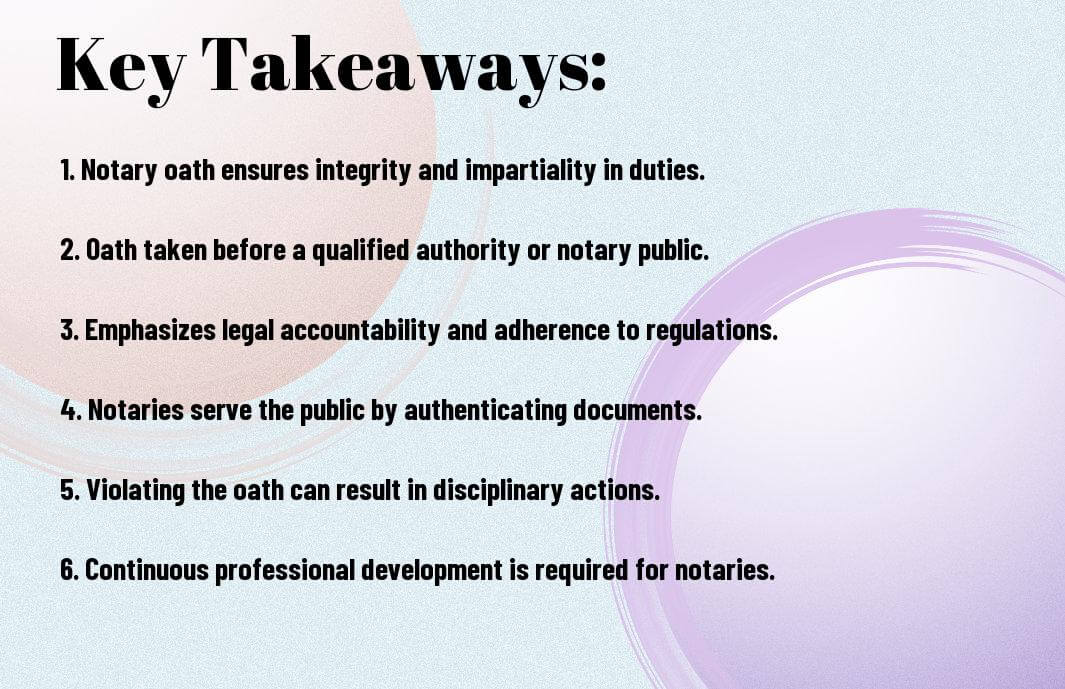
Key Takeaways:

  • Notary Oath: The Notary Oath is an vital declaration that a notary public must take to uphold their responsibilities with honesty and integrity.
  • Legal Authority: This oath grants notaries the legal authority to perform various duties such as witnessing signatures and authenticating documents.
  • Professional Conduct: Taking the oath ensures that notaries adhere to high standards of professional conduct, fostering trust in their services.
  • Compliance: Notaries are required to comply with the rules and regulations set forth by governing bodies to maintain their commissioned status.
  • Public Trust: The oath emphasizes the importance of public trust in the notarial process, promoting accountability and ethical behavior.

The Role of Notaries in the UK

To understand the vital function of notaries in the UK, you should know that they serve as impartial witnesses in legal matters, ensuring the authenticity of documents. Notaries play a critical role in verifying identities, administering oaths, and overseeing important transactions, especially when dealing with international legal matters. Their work helps you navigate complex legal landscapes, providing assurance and security in your dealings.

Historical Context

By exploring the historical context of notaries in the UK, you can appreciate the evolution of their role, dating back to ancient Rome. Originally serving as scribes and record-keepers, notaries have developed into key figures in legal transactions, adapting to changing laws and societal needs over centuries.

Functions and Responsibilities

Among the primary functions of notaries in the UK are the preparation, authentication, and certification of documents. They also handle matters such as powers of attorney, affidavits, and the execution of documents for use abroad, ensuring they comply with legal standards.

Consequently, notaries act as your trusted advisors, verifying the legality and validity of documents involved in various transactions. They are responsible for ensuring that all actions comply with the law, protecting your interests by preventing fraud. In addition to witnessing signatures, notaries may also provide legal advice and assistance in cross-border matters, which can be incredibly beneficial in an increasingly globalized world. Their expertise ensures the smooth execution of legal processes, allowing you to focus on your affairs with confidence.

The Notary Oath: An Overview

Clearly, the Notary Oath is a formal declaration that signifies your commitment to uphold the duties and responsibilities associated with your role as a notary public in the UK. By taking this oath, you affirm your dedication to providing impartial and accurate notarization services, thus ensuring the integrity of legal documents and transactions for those you serve.

Purpose and Significance

Beside establishing a foundation of trust, the Notary Oath serves to reinforce your accountability and ethical conduct as a notary public. This solemn commitment is vital for maintaining public confidence in the notarization process and ensuring that your actions are aligned with legal standards and professional guidelines.

Components of the Oath

Behind the Notary Oath lies a series of vital components that outline your responsibilities and ethical obligations as a notary public. These components often include affirmations of honesty, impartiality, and commitment to safeguard the interests of all parties involved in the notarization process.

This framework encapsulates the key tenets you must uphold, such as the obligation to act fairly and without bias, as well as to maintain confidentiality concerning the information you encounter. By articulating these principles, the request for loyalty to the law and your role in facilitating legal processes is clearly communicated. Each element of the oath not only emphasizes the significance of your role but also serves as a guide for maintaining professional integrity and ethical standards throughout your career.

The Process of Taking the Notary Oath

Despite the formal nature of the notarial process, taking the Notary Oath is designed to be straightforward. You will typically perform the oath in front of an official authority, such as a judge or another notary. This step solidifies your commitment to the responsibilities and ethical standards expected from you as a notary public.

Requirements for Notaries

Before you can take the Notary Oath, you must meet specific requirements. These include being over 18, possessing the requisite qualifications, and having a clear understanding of the notarial duties. Familiarizing yourself with these criteria is necessary to ensure a smooth process.

Steps Involved

Around the time you are ready to take the oath, there are several steps you must follow. These include gathering your documentation, confirming your eligibility, and scheduling an appointment with the relevant authority where you will take your oath.

Steps to take the Notary Oath include compiling necessary documents such as proof of identity and your qualifications. You will then need to find a suitable authority to administer the oath; this could be a qualified notary or a judge. Once your appointment is set, be prepared to affirm your commitment to uphold notarial duties and adhere to the legal standards governing your role. After taking the oath, you will be officially recognized as a notary public, allowing you to commence your practice.

Implications of the Notary Oath

Unlike many professions, the Notary Oath entails a significant level of responsibility and trust. As a notary, you must understand that the oath not only underpins your practice but also holds legal and ethical implications that can affect both you and your clients. Adhering to this oath is fundamental to maintaining the integrity of your role and the validity of the documents you notarize.

Ethical Obligations

Notary professionals are bound by a stringent set of ethical obligations that emerge from their oath. You are expected to act impartially and maintain confidentiality, ensuring that your services are accessible to all parties without bias. Upholding these ethical standards is crucial for fostering trust and integrity in your practice.

Legal Consequences

Beside the ethical expectations, there are strict legal consequences for failing to uphold your obligations as a notary. Violations can lead to disciplinary actions, including fines or suspension of your notary commission. In some cases, you may also face civil liability if your improper actions result in damages.

To understand the gravity of these legal consequences, you should recognize that any mistakes or misconduct can have far-reaching effects on your career. Poorly executed notarization, or failing to adhere to the proper processes, could compromise the legality of the documents you handle. Therefore, it’s vital to stay informed about the laws and regulations that govern your practice, as the penalties for violations could impact your professional reputation and financial stability.

Challenges Faced by Notaries

Now, as a notary, you encounter various challenges that can impact your daily responsibilities and the confidence of your clients. These difficulties range from administrative burdens and ethical dilemmas to adapting to evolving legal frameworks. Understanding these challenges is vital for your professional development and ensuring efficient service delivery.

Common Issues

Along your journey as a notary, you might encounter common issues such as high workloads and the necessity of remaining updated on legal requirements. These challenges can sometimes lead to oversights, which may have significant implications for the validity of your notarizations.

Regulatory Changes

For notaries, staying informed about regulatory changes is imperative to maintain compliance and protect your practice. The legal landscape surrounding notarial services can shift, requiring you to adapt quickly to new guidelines and requirements.

Understanding these regulatory changes allows you to enhance your practice effectively. By keeping abreast of updates from governing bodies, you ensure that your notarial acts are performed within the legal framework, safeguarding both your practice and your clients’ interests. Engaging in continuous professional development is an excellent way to stay informed, giving you the tools necessary to adjust to any upcoming legislative transformations.

Resources for Aspiring Notaries

Many individuals looking to become notaries in the UK can avail themselves of various resources that will aid in their journey. Understanding the core requirements, accessing training programs, and connecting with professional associations will provide you with the foundation and support needed for a successful career as a notary. Utilizing these resources will better prepare you for the responsibilities that lie ahead.

Training and Certification

Training is a vital component in becoming a certified notary. You will need to engage in a reputable training program, which usually covers the legal frameworks and practical skills required in notarial practice. Certification will usually follow your training, demonstrating your competency in fulfilling notarial duties.

Professional Associations

Training is further supported by professional associations that offer networking opportunities, resources, and guidance to notaries. Joining such associations can enhance your credibility and provide you with updated information relevant to your practice.

To successfully navigate your career, you should consider enrolling in organizations like the Notaries Society or the FNPN, which serve as platforms for continuing education, professional development, and community engagement. These associations often provide access to specialized training sessions, webinars, and mentorship programs that will enrich your understanding and skills in notarial work.

To wrap up

With this in mind, understanding the Notary Oath in the UK is vital for your role as a notary public. This solemn commitment underscores your dedication to honesty and integrity in executing your duties. By grasping the significance of the oath, you ensure that your practices align with legal standards and ethical expectations. Adhering to this oath not only enhances your professional credibility but also fosters trust with the clients you serve. Your commitment to upholding these values reflects positively on the entire notarial profession.

Q: What is the purpose of the Notary Oath in the UK?

A: The Notary Oath in the UK serves to uphold the ethical and professional standards required of a notary public. By taking the oath, notaries commit to performing their duties impartially and competently, ensuring the authenticity of legal documents and the accurate execution of legal procedures. This is vital in maintaining the trust of the public and legal institutions in the notarial process.

Q: Who is required to take the Notary Oath in the UK?

A: The Notary Oath must be taken by individuals who wish to practice as notaries public in the UK. This generally includes solicitors who have completed additional training specific to notarial work, and independent notaries who have undergone the necessary education and examinations. Only after completing this process and taking the oath can they officially act as a notary in legal matters.

Q: What are the consequences of not adhering to the Notary Oath?

A: Notaries who fail to adhere to the commitments made in the Notary Oath could face serious repercussions. This may include disciplinary actions by professional bodies, the loss of notarial status, and potential legal consequences for misconduct. Upholding the oath is important not only for the individual’s professional reputation but also for maintaining public confidence in the notarial system.

The Evolution of Notary Services in the UK – Past, Present, and Future

You may not realize how significantly notary services have evolved in the UK over the years. From their origins steeped in medieval tradition to modern digital practices, notaries have adapted to meet the demands of a changing society. In this blog post, you’ll explore the key milestones in the history of notary services, understand their current role in legal and business matters, and gain insight into future trends that may reshape this vital profession. Join us on a journey through time to see how notaries continue to play an important role in our everyday lives.

Key Takeaways:

  • Historical Context: Notary services in the UK have a rich history, evolving from simple document verification to an imperative part of legal processes.
  • Modernization: The current digital age has led to advancements such as online notary services, making the process more accessible and efficient.
  • Regulatory Changes: Recent reforms aim to enhance the professionalism and integrity of notarial practices, ensuring trust in the services provided.
  • International Influence: Globalization has impacted notary practices in the UK, with a growing need for cross-border services among different legal systems.
  • Future Trends: The future of notary services may include increased automation and integration of technology to meet evolving consumer needs.

Historical Overview of Notary Services

Before the establishment of modern regulations, notary services in the UK had a rich history rooted in the need for legal documentation and authentication. As society evolved, so did the roles and responsibilities of notaries, adapting to the demands of changing legal and business landscapes. Understanding this history provides valuable context for how notary services function today.

Origins of Notary Services in the UK

Services that resembled notary functions date back to ancient civilisations, but in the UK, they began to take shape during the medieval period. Notaries were initially clerics or members of the Church, facilitating transactions and ensuring that documents were accurately recorded. These early notaries played an vital role in commercial activities and legal matters.

Development Through the Ages

Across the centuries, notary services evolved significantly, reflecting broader societal changes. Originally, notaries operated mostly within ecclesiastical courts, but by the Renaissance, their responsibilities expanded to encompass a wider array of transactions and documentations. The emergence of trade agreements and the rise of commerce during this period fueled the need for reliable documentation, prompting the formal recognition of notaries as legal professionals.

Hence, the development of notary services through the ages highlights the necessity for trustworthy documentation in an increasingly complex society. As trade expanded and legal systems became more intricate, notaries adapted by honing their skills in drafting and authenticating documents, solidifying their position as key players in the legal landscape. By the time the Notaries Act of 1801 was enacted, notaries had established a clear role in law and commerce, setting a precedent for the notarial services you rely on today.

The Role of Notaries in Modern Society

If you think of notaries merely as witnesses to signatures, it’s time to reconsider. Notaries serve as vital intermediaries in your legal and business transactions, ensuring the authenticity of documents and safeguarding against fraud. Their unique position in society allows them to facilitate international dealings, uphold legal frameworks, and provide specialized services tailored to the growing complexities of modern life.

Current Functions and Responsibilities

With a focus on verification and authentication, today’s notaries perform a range of functions, including preparing and certifying documents, administering oaths, and providing legal advice on various matters. You can rely on notaries to help with estate planning, business transactions, and international agreements, ensuring that your documents hold up under scrutiny.

Regulations Governing Notary Practices

After you engage a notary, it’s vital to understand that their services fall under strict regulations and oversight to maintain integrity and public trust. This framework ensures that notaries adhere to high professional standards and remain accountable for their actions.

Plus, these regulations are designed to protect you as a client, outlining the qualifications and ethical practices a notary must uphold. In the UK, notaries are typically governed by the Notaries Act of 1815 and regulated by both the Faculty Office and the Notaries Society. These bodies not only mandate rigorous training but also enforce continuing education and professional conduct, ensuring that notaries remain qualified to assist you in a rapidly changing legal landscape.

Technological Advancements and Notary Services

Once again, the landscape of notary services is being reshaped by technological advancements. Emerging technologies, including artificial intelligence and blockchain, have streamlined various processes and improved efficiency. As you engage with notarial services, it’s vital to understand how these innovations can enhance your experience, making transactions more reliable and secure.

Digital Notarization and E-Notaries

An increasing number of notaries are now offering digital notarization services, allowing you to sign and validate documents online. This shift not only saves time but also expands access, enabling remote transactions that cater to your busy lifestyle. With e-notaries, you can complete vital paperwork without the complications of travel or waiting.

The Impact of Technology on Traditional Practices

Against a backdrop of rapid technological change, traditional notary practices are evolving. The integration of electronic tools in notarization processes challenges longstanding methods, prompting you to adapt to new practices that foster efficiency while maintaining legal security.

Traditional notary practices often relied heavily on face-to-face interactions and paper documents, creating time-consuming processes. In contrast, technology allows you to engage in notarization seamlessly, whether from your home or office. You’ll benefit from improved access and flexibility, as digital collaboration tools and secure document-sharing platforms enable you to complete your notary needs without interruption. This shift not only enhances efficiency but also maintains the integrity and security of the notarization process, proving that modern advancements can coexist with age-old traditions.

Challenges Facing Notary Services Today

Despite the longstanding importance of notary services in the UK, today’s landscape presents various challenges. Increased digitalization, evolving client expectations, and stringent regulatory requirements put pressure on notaries to adapt and innovate. The need for enhanced efficiency while maintaining credibility is paramount, as you navigate these complexities in a rapidly shifting environment.

Legal and Ethical Considerations

Today, you must remain vigilant regarding legal and ethical considerations in notary services. Compliance with various regulations ensures that you uphold integrity and public trust in your profession. Balancing your duties while adhering to these legal frameworks is crucial to safeguarding your reputation and that of the notary profession as a whole.

Competition from Alternative Services

Across the sector, you face stiff competition from alternative services that offer similar document verification options. Innovations such as online notarization and automated platforms create a challenge for traditional notary services to maintain their client base.

Also, the rise of digital platforms and online services has transformed the notary landscape, presenting both challenges and opportunities for your practice. Many clients now opt for faster, more convenient alternatives that digital services provide, often compromising personal interaction for efficiency. To remain relevant and competitive, you will need to consider integrating technology into your services while emphasizing the personalized support and expertise that only you can provide. Building a strong online presence and adapting to these changing demands will be crucial for sustaining your notary practice moving forward.

The Future of Notary Services in the UK

Unlike traditional practices, the future of notary services in the UK will likely be shaped by technology and evolving consumer needs. As digital transformations occur, you can expect notarial services to become more accessible and streamlined. Innovations in online document authentication, remote notarisation, and secure digital signatures will redefine the landscape, allowing you to complete notarial processes more efficiently while maintaining high standards of security and compliance.

Predictions for the Next Decade

Below, you’ll find insights into what you might anticipate in notary services over the next ten years. With the adoption of advanced technologies and an increased focus on client convenience, notary services could see enhanced accessibility and efficiency. Embracing online platforms and digital verification will transform how you interact with notaries.

The Evolving Legal Landscape

After a thorough look at the current trends, you may notice a shift towards a more digitised and interconnected legal environment. The processes in which you engage with notaries will be influenced by changes in legislation and greater global connectivity. Increased collaboration among legal professionals will enhance the overall experience for clients, streamlining procedures on various fronts.

Predictions indicate that the evolving legal landscape will necessitate continuous adaptability among notary services. You can expect stronger regulatory frameworks and potential new guidelines that govern how notaries operate in a digital-first world. This transformation will ensure you have access to secure and efficient services tailored to meet your modern needs, fostering trust and reliability in your transactions.

Global Perspectives on Notary Services

After examining the evolution of notary services in the UK, it’s necessary to consider how these practices compare globally. Notaries across the world fulfill similar roles, but each country’s regulations and processes may differ significantly, shaping how you utilize notary services in your own jurisdiction.

Comparison with International Practices

At the international level, notary services vary widely in scope and authority. The following table illustrates key differences:

International Notary Practices

Country Regulations and Powers
USA State-specific regulations; limited authority.
France Notaries have extensive legal powers; trusted for complex transactions.
Germany Highly regulated; responsibility for document authenticity.
Japan Involvement in property and corporate transactions; judicial functions integrated.

Lessons from Other Countries

The global landscape provides valuable insights into enhancing notary services in the UK. You can learn from effective practices elsewhere that promote efficiency, security, and accessibility, setting a more user-centric approach for notary services.

Considering the lessons from various countries, it becomes clear that embracing a more standardized and user-friendly framework could significantly improve your experience with notary services. By examining successful models from nations like France and Germany, you can advocate for reforms that streamline processes, boost trust, and ensure you receive the highest quality service tailored to your needs.

To wrap up

So, as you reflect on the evolution of notary services in the UK, you can appreciate how they have adapted to changing legal landscapes and technological advancements. The journey from traditional roles to modern practices highlights the importance of notaries in safeguarding your transactions today and in the future. For a deeper understanding, you may want to explore this Short History of the Notary Public. Your awareness of these developments will empower you to navigate your legal needs with confidence.

FAQ

Q: How have traditional notary services in the UK changed over the decades?

A: Traditional notary services in the UK have undergone significant changes over the decades, adapting to advancements in technology and shifts in societal needs. Historically, notaries primarily focused on witnessing signatures and authenticating documents. However, with the rise of digital communication and electronic transactions, many services have transitioned to offering online notarization. This evolution has enabled notaries to provide more efficient services while catering to a diverse clientele that values convenience and speed.

Q: What role does technology play in the current state of notary services in the UK?

A: Technology plays a transformative role in the current state of notary services in the UK. The introduction of digital tools allows notaries to remotely conduct meetings, verify identities through secure online platforms, and manage document signings efficiently. Electronic notary services have emerged, facilitating rapid processing times while maintaining security and compliance with legal standards. This technological advancement has not only expanded access to services but has also streamlined workloads, contributing to a more dynamic environment for notary services.

Q: What can we expect for the future of notary services in the UK?

A: The future of notary services in the UK is likely to be characterized by continued digital innovation and further integration of artificial intelligence. As regulations evolve to accommodate technological changes, we may see an expansion of services including automated verification processes and enhanced cybersecurity measures. Additionally, as remote work becomes more prevalent, the demand for online notary services is expected to grow. This progression will create new opportunities for notaries to adapt and offer more flexible solutions to meet the needs of clients in an increasingly digital world.

Skip to content